Nov 01, 2026 I Elias Mercer
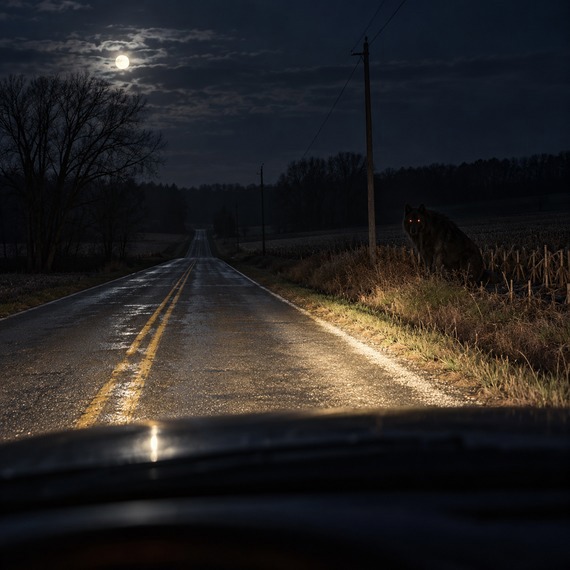
Lee Hampel dates his first sighting to 5 May 2017. He was leaving his Wisconsin farm when he saw two orange-red eyes beside the road, about three feet above the ground. Whatever held them moved down an embankment, he says, then looked back over its grassy top. The change in height was part of what troubled him. He believed he was watching something capable of crouching low and then rising much higher.
By then, Hampel had already spent years wondering what visited his property. Neighbours had told him about a wolf-like creature. He had begun putting out cameras, collecting tracks and watching what happened to animal carcasses left in the field. His investigation gradually acquired a cast of things that seemed to belong to different stories: an upright beast, unfamiliar prints, disappearing roadkill, lights in the sky and patches of mist that obscured his photographs.
That is the world Meagan Medick enters in a new episode of NewsNation’s Unreported, filmed near Elkhorn, Wisconsin. Released on YouTube on 29 October, the 41-minute programme gives Hampel time to walk through his evidence and the places where he collected it. For anyone who remembers the Beast of Bray Road as a werewolf glimpsed by frightened motorists, this is an absorbing look at how much stranger the story has become.
The conversation after the hay was baled
Hampel tells Medick that he bought the farm in 2007 without knowing about the beast. The subject arrived in September 2013, after neighbours helped him bale hay. As they talked in his shed, one told him that a werewolf lived on the property. Hampel, a teacher with a background in mathematics and computer science, initially dismissed the suggestion. Then came the names of people who supposedly had seen it.
The film briefly leaves the farm to ask Elkhorn residents what they think. Some readily accept the beast; one man describes it as a folk tale. Hampel’s response has become a sustained investigation. He says he has kept more than 200 camera memory cards and accumulated over 100,000 images he considers paranormal. Whatever first drew his attention has held it through years of checking cameras and returning to places where something unexpected appeared.
Out in the fields, he retraces an encounter in which he says a large figure crouched near the woods, moved while low to the ground, then stood and walked towards the trees. It dropped to all fours before disappearing into them. He points out where he stood taking photographs and where he subsequently looked for tracks. The ability to move between an upright stance and all fours is central to his description, as it has been to many reports associated with Bray Road.
The surroundings give the sequence its interest. Medick is shown the cornfield, the woods and the distance between them. This is working farmland with neighbouring properties and people passing through their ordinary routines. Towards the end, she asks why a creature seeking concealment would remain in such a place. Hampel has no location to offer beyond the one he has been watching: it keeps happening here, he says.
Five toes, seven pads
Hampel’s most persistent argument rests on the tracks. He describes impressions with five toes, a central pad and a heel pad: seven pads altogether. He has photographs, casts and a model made from his material. In his account, the same unusual configuration recurs often enough to be recognisable, including in snow and in lines crossing the fields.
Medick looks at the ground with him and tries stepping between marks. They discuss the spacing, the straightness of some trails and photographs in which one apparent trackway separates into two. Hampel interprets those patterns as upright animals following one another before branching apart. The programme makes his reasoning easy to follow by letting him point to the details he considers important.
It also includes an explanation he rejected. Hampel recounts contacting a tracking specialist recommended through Chicago’s Field Museum. According to his account of the correspondence, the specialist proposed overlapping tracks from two animals. Hampel disputes that reading and says he has followed the unusual impressions over substantial distances. Hampel’s disagreement keeps bringing him back to the trails themselves, which he believes show the movements of something unusual across his land.
The tracks give the film a tangible centre. Hampel can take Medick into the fields, point to a trail and explain what drew him along it. The impressions carry the encounter beyond a few frightening seconds beside the road. For him, they suggest a visitor that returns, moves through the property and leaves signs of its passage for someone patient enough to look.
The deer the camera did not see move
The carcass accounts are more disturbing. Hampel says that road-killed raccoons and deer placed on his land were opened, moved, partly removed or carried away. In one early incident, a raccoon he left in tall grass was later found opened along its body, then moved to another spot. He initially suspected someone was interfering with him.
A deer sequence takes the problem further. Hampel shows photographs of a buck in one position and then another, without an image clearly recording whatever moved it. He points to vegetation he believes should have been disturbed if the carcass had been dragged. Later, he takes Medick to the trees where he says it became lodged. The walk between the photographs and the actual ground is among the film’s most useful passages.
Medick asks about the intervals between triggered photographs. Hampel also describes longer gaps in recording. The unanswered movement between images becomes part of the farm’s larger mystery. Something shifted the deer, yet the equipment placed there to reveal the visitor left him confronting its absence. The photographs show him where to resume looking without showing what he most wants to see.
More recent experiments involve chickens placed on a wagon and beneath barrels, with security cameras added near the buildings. Hampel is still changing the arrangements, hoping to capture what he believes earlier cameras missed. The programme’s occasional jokes about the bait give these scenes a conversational tone, giving the investigation a sense of the everyday life that continues around it.
Linda Godfrey had been in this field before
Linda Godfrey’s work belongs directly in this story. As a reporter for The Week, she brought the local upright-canid reports to wider attention. Writing in 2017, she noted that the accounts reaching her included unusual lights and reddish, Bigfoot-like creatures as well as wolf-like animals walking upright. Bray Road’s reports had already outgrown a single description.
She also investigated Hampel’s own property. In an October 2016 post, she identified him as the witness called “Roy Smith” in her book Monsters Among Us, explaining that he had chosen the pseudonym and subsequently decided to use his real name. She described an April 2015 camera image of a dark form apparently crouched in the hay. To examine its possible size, she went into the field for comparison photographs. A similar image from May 2016 prompted another comparison, this time with Hampel.
Godfrey went into the field to consider the shapes against a human figure and the surrounding landscape. Her comparison photographs preserve the practical side of an investigation already running for years before Medick’s visit. That history becomes especially intriguing when Hampel recalls reviewing another sequence with her: one in which mist appeared to conceal part of his own body.
When the beast becomes a larger mystery
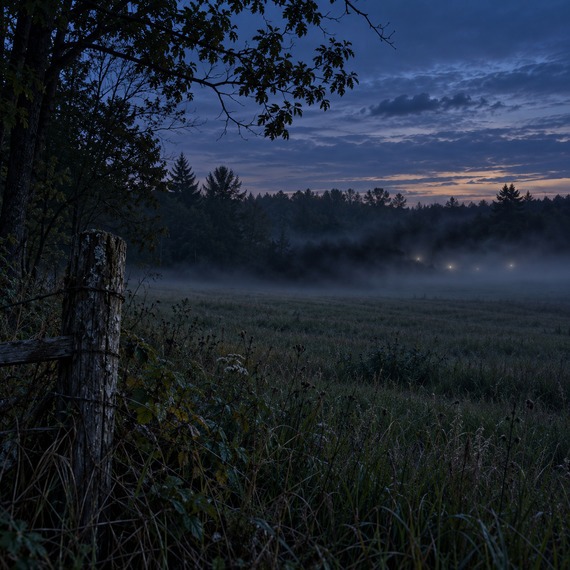
In the final third, Hampel shows camera images containing small bright objects that seem to change number between frames. He believes they are connected with the creature. He also describes dark, white or brown obscurations appearing in sequences around the carcasses, sometimes when the event he wanted recorded went unseen.
Hampel says he and Godfrey visited a deer in his field and checked the camera card together. An earlier image showed the mist he associated with the disturbances. In a photograph of himself approaching the deer, part of his lower body appeared obscured; an image taken seconds later was clear. To Hampel, it suggested the obscurations could hide more than a passing animal. The camera had caught him within the mystery he was trying to record.
Here the episode becomes more than a retelling of a roadside wolfman. Hampel’s encounters draw the creature, the lights and the obscurations into a larger picture of the property. Godfrey’s interest in creatures, apparent portals and other unusual phenomena offers a rich companion to that picture, opening a way into a mystery that seems to resist remaining within the outline of one animal.
A return to a place that keeps its secrets
Unreported works best as a patient introduction to Hampel and the material that has held his attention. Medick asks him to explain, goes to the locations and allows the conversation to retain its informal, sometimes awkward humour. There is value in seeing the distances, grass, camera positions and neighbouring fields instead of hearing another compressed account of a monster somewhere in Wisconsin.
The film is strongest when Medick follows Hampel through the details of his experience. The changing camera arrangements, the tracks crossing a field and the walk towards the trees give the story a physical presence. Viewers spend time in the places that keep drawing him back. His persistence makes him an engaging subject, and the programme conveys the pull of an investigation that has become part of daily life.
A further visit would be welcome to follow the investigation as it continues. Hampel is still adjusting cameras and testing arrangements, while the material already collected keeps sending him back into the fields. The compelling promise of another chapter is the possibility of watching the next encounter emerge from a place that has already given him so much to pursue.
As a visit to a long-running local mystery, however, it is well worth watching. It presents a man who has spent years making records and changing his methods, with no intention of stopping. Read beside Godfrey’s field reports, the new episode also shows how much continuity there is beneath the latest headline. The same patch of Wisconsin hayfield has been drawing questions for years, and the questions have become increasingly difficult to fit inside the outline of a wolf.
Watch the full documentary
The complete 41-minute episode of NewsNation’s Unreported with Meagan Medick is available to watch on YouTube. Its title is “It’s not normal” | Mysterious creature with alleged UFO ties plagues Wisconsin farm town.
Further Reading
Keep listening
Linda Godfrey’s research into Dogmen, Bigfoot and stranger encounters is explored in 26.21, The Garuda Monks, an episode of the Mysterious Universe Plus+ podcast celebrating her work. Join Mysterious Universe Plus at the Max tier to stream it and discover more from the available back catalogue.
Trending Podcasts
-
 36.13 I MU Podcasts
36.13 - MU Podcast - MU Interviews - Charlie Robinson - 002
-
-
 36.14 I MU Podcasts
36.14 - MU Podcast - The Tayos Caves Mystery Part 1
-
 36.16 I MU Podcasts
36.16 - MU Podcast - Beneath the Pyramids
-
-
 36.12 I MU Podcasts
36.12 - MU Podcast - The Skill Trap | Outsourcing Ourselves
Latest Articles

Elias Mercer writes about unexplained phenomena, unusual encounters and the stories that gather around mysterious places. His features connect contemporary reports with older accounts, exploring the details that make them worth remembering.
Previous article
Related Articles