

Dec 23, 2025 I Marcus Lowth
At 5.46 on the evening of 6 January 2025, security staff at Louisiana's River Bend nuclear station reported approximately five black, rectangular objects flying over the reactor building. They saw no lights. The estimated height was a hundred feet above the building, and the objects were lost from view to the south four minutes later. The plant heightened its security posture and notified outside authorities. In the incident record, the objects were called drones. Whoever was flying them was not identified there.
The description sits among pages of reports recently made public by the US Nuclear Regulatory Commission. Other entries concern flashing lights, hovering aircraft, brief passes over industrial buildings and repeated appearances around the same properties. Read individually, they are short security incidents. Read together, they describe a succession of unwelcome visitors over places where an unknown aircraft is difficult to dismiss as somebody else's problem.
The records attracted renewed attention in October 2026, with American Buildout reporting on the newly available material. Their entries stretch across earlier months and years, preserving varied visitors. Some observers saw bodies and propellers; others watched little more than lights. The word drone gave the incidents a working description. The unanswered questions remained close to the ground: who was operating the aircraft, where had they come from and why were they returning?
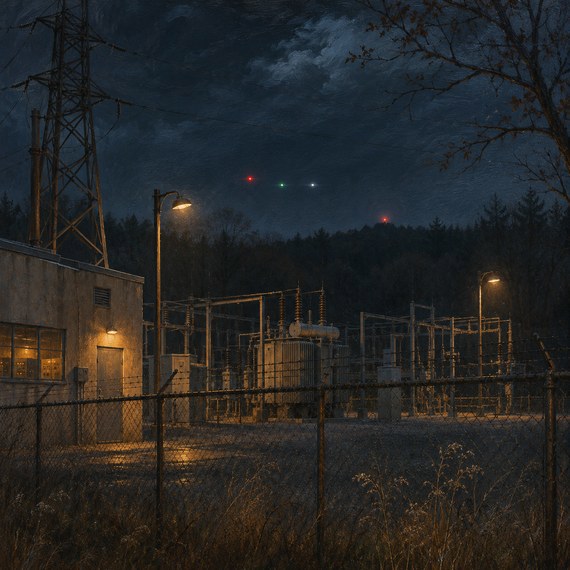
River Bend had already been receiving such reports before the five dark shapes appeared. On 30 December 2024, a drone was described as three to four feet wide, with four propellers, a central body and green, red and flashing white lights. It passed into the protected area, then hovered elsewhere within the plant's owner-controlled grounds. Security eventually lost sight of it below the tree line. Unlike a featureless point in the sky, this description gave observers an apparently familiar kind of machine to look at. Familiarity did not make its presence any more welcome.
On New Year’s Day, an employee told security six drones were over the protected area. A call five minutes later said they had gone. On 2 January, personnel watched red, green and white lights before losing them beneath the trees. Then came the unlit rectangular shapes on 6 January. The repeated appearances gave staff more to report, while the changing outlines made the sequence increasingly difficult to reduce to one familiar flight.
Lights that returned
The Illinois entries provide another sequence. At Clinton on 12 September 2025, two officers reported four or five drones with red and green lights flying in a circular pattern near a discharge area. After departing, three returned and repeated the behaviour. The account records their eventual departure and a later sighting by local law enforcement in DeWitt. This was more than a solitary light crossing an observer's field of view. The reported return gave staff another opportunity to watch the activity, without the public entry supplying an explanation for it.
Two evenings later, officers again reported drones near Clinton. An update described an object seen from the west side, showing red and white lights over the protected area. The observer followed it across the grounds and over the lake until its lights appeared to switch off. Once again, something crossed the facility and slipped beyond observation before the people watching could establish where its flight would end.
At nearby Braidwood, a report from the same evening described two separate objects with strobing red and white lights. One travelled steadily through the protected area. The other appeared to hover briefly, then climbed until it could no longer be observed. Altitude and evening light concealed the finer details, leaving the observers to follow the changing positions of the strobes. One visitor crossed the grounds while the other lingered and climbed, drawing attention to more than one part of the sky.
At Surry on 12 December 2024, an off-duty security officer reported a drone with a steady white light. Security contacted the Fort Eustis control tower; its recorded response placed a drone on radar at about three hundred feet. Later observations included a cluster of lights and a deputy reporting three drones leaving the county. Sightings were becoming tracks and official calls, yet the flights continued beyond the people trying to follow them.
These episodes become stranger through accumulation rather than any single extravagant detail. A low flight is reported. Calls are made. Sometimes police arrive in time to see something; sometimes they do not. Lights go behind buildings or trees, or recede until observers lose them. The last line often concerns notifications rather than identification. The official account remains suspended at the point where someone else might have been expected to explain the presence of the aircraft.
Across midnight
At Byron in Illinois, the activity recorded on the night of 24 March 2026 continued across midnight. Staff first observed a drone travelling over the protected area at about 11.10 pm. After midnight, security officers and local law enforcement identified two separate drones over the owner-controlled and protected areas. Activity continued until 1.30 am. The entry records contacts with the FBI, the FAA and the sheriff's department. It contains no public resolution identifying who had been responsible for those flights.
On 9 February 2026, a contractor contacted security at the Three Mile Island site to report a low-flying drone with three lights over the north end of the island. It was said to have remained for four or five minutes before leaving. Responding security staff did not see it, and state police who attended later did not see it either. The FAA also mentioned an earlier drone report near Harrisburg International Airport, adding another nearby observation for those handling the response to consider.
The contractor’s account captures how quickly an opportunity to see a visitor can close. By the time responding personnel arrived, the lights had left the island. The concern remained, passed to staff and police who now had a description to work from. Alongside the longer observations elsewhere, it gives the records their recurring rhythm: an appearance, a call for assistance and another search beginning after the aircraft has gone.
The helicopter that searchers could not find
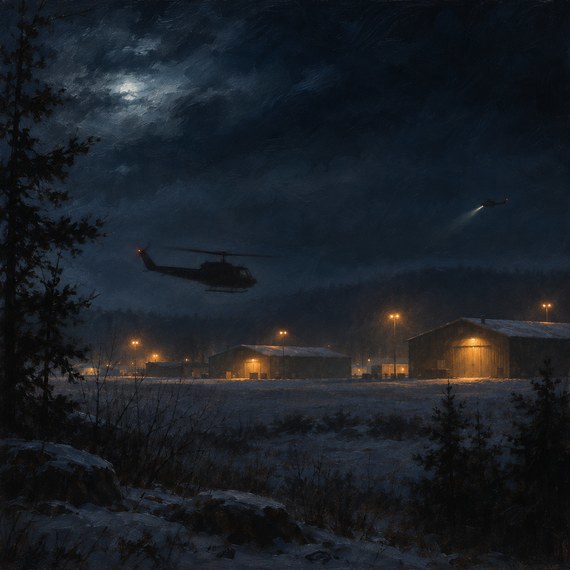
Half a century earlier, military personnel were dealing with another series of unwanted flights near a nuclear weapons storage area. At Loring Air Force Base in Maine in October 1975, the contemporary language was unidentified helicopter. A National Military Command Center memorandum dated 29 October reported that one, possibly two, had been seen flying low near the weapons storage area. An Army National Guard helicopter had been called to help locate them. By the time an update reached the command centre, that responding crew had not sighted the intruders.
Another update placed an unidentified helicopter roughly three hundred to five hundred metres from the storage area, at an estimated altitude of a hundred and fifty feet. An attempt to make contact and establish its identity was unsuccessful. A further sighting over the storage area prompted another unsuccessful response. Coordination extended to Maine State Police and the Royal Canadian Mounted Police. Permission had been obtained to pursue into Canadian airspace if necessary. The search had reached beyond the base without producing an identification in those memoranda.
The terse documents give Loring’s intrusions a particular immediacy. Military personnel coordinated an aircraft search, passed sightings between agencies and prepared for pursuit across an international border. The reported helicopter remained elusive through those efforts. The record follows the response in detail, bringing the reader close to a search whose central visitor seemed always to be somewhere beyond the next update.
Loring’s weapons storage area and the civilian facilities in the NRC file belong to different settings within the nuclear world. Across the decades, their personnel faced a similar problem. Something entered a place whose security mattered intensely. They could summon assistance and pass its position onwards, but the flight could still end without anyone establishing who had been above them or why they had come.
Even the closing language leaves an unfinished impression. The database uses Closed Unresolved, while some narratives retain wording about further review. The administrative record can reach its end while an encounter continues to invite attention. Returning to the entries, readers can follow what the observers saw and how far the search for their visitors was able to go.
The persistence is unsettling in itself. Lights return to the same grounds; dark shapes cross above a reactor building; flights continue while authorities work to follow them. At Loring, searchers went up without finding the helicopter reported below. At River Bend, five dark objects were lost to the south. Decades apart, the records leave the people watching a sensitive place still looking beyond its boundary.
The records leave a lasting impression of people doing their work while an unfamiliar visitor draws their attention upwards. Buildings, tree lines and stretches of water become the landmarks against which the flights are followed. Each entry briefly opens that scene to the reader, then ends while the larger question about the visitor is still in the air.
Further Reading
- NRC drone incident records
- The October report on the NRC release
- Military UFO records including Loring
The longer history of strange encounters around nuclear facilities is explored in 32.01, Atomic Confessions, featuring the work and reported experiences of Robert Hastings. Join Mysterious Universe Plus+ at the Max tier to stream the episode and explore the available back catalogue.
Trending Podcasts
-
 36.13 I MU Podcasts
36.13 - MU Podcast - MU Interviews - Charlie Robinson - 002
-
-
 36.14 I MU Podcasts
36.14 - MU Podcast - The Tayos Caves Mystery Part 1
-
 36.16 I MU Podcasts
36.16 - MU Podcast - Beneath the Pyramids
-

-
 36.12 I MU Podcasts
36.12 - MU Podcast - The Skill Trap | Outsourcing Ourselves

Julian Vale writes about strange encounters, unexplained events and the mysteries of remote places. His features bring together eyewitness accounts and overlooked stories, following the connections between experiences separated by time and geography.
Previous article
Related Articles