
Nov 13, 2026 I Julian Vale
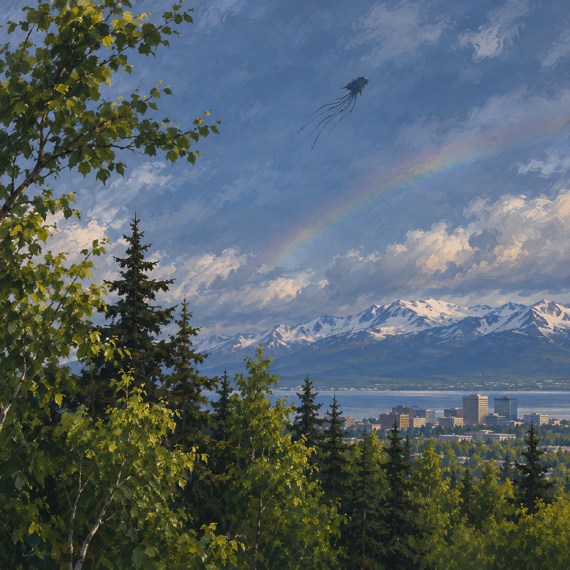
Sara Jane Osborn had been taking pictures of a rainbow over Anchorage when something small and dark appeared in her view. A mosquito was her first thought. She looked away from the phone and realised she was seeing something farther out, above the trees. It had a dark upper shape and what looked like hanging extensions. In her description, those lower parts appeared to move separately. The rainbow had been reason enough to stop. Now she was pointing the camera at something for which she had no immediate name.
Watch Sara Jane Osborn’s footage here.
This was the evening of 15 June 2026. Osborn said she and her husband had been driving along Sixth Avenue when he pulled over so she could get her pictures. She placed the recording near the old Northway Mall. For those who came to the footage through the coverage of 10 and 11 November, it felt like a fresh appearance over Anchorage. The interval belongs to the circulation of the story. The couple had seen the thing nearly five months earlier, under a summer sky with enough light left to make out both the rainbow and the shape below it.
Osborn said they drove over to look for it. They came away without seeing it again. In an account reproduced in November coverage she recalled a plane passing afterwards, which gave her another sight against which to think about what she had just seen. She was left with an impression of something large. The difficulty is placing it in depth. A far tree line gives a shape a place on the screen. It only gives the shape a distance if the shape and the trees can be put in relation to each other. In a phone image there is plenty of room between an object looking small and it actually being small.
What hangs underneath
People quickly reached for the word jellyfish. There is a good reason for the name if you are trying to tell someone what to look for. The body and the trailing shapes seem to belong to different kinds of movement. When we see an aircraft, most of the outline moves together. When we see something with long loose parts beneath it, the eye goes to the parts that keep moving after the upper shape seems to have settled. It looks, for a moment, like something under water. That impression can survive a poor view of almost every other feature.
An octopus or jellyfish kite is a plausible suggestion. Flexible arms are precisely what make that kind of kite look alive at a distance, and their movement can continue while the body seems to hang in one place. Osborn said she did not think she was seeing a kite and described looking for the object after leaving the spot where she filmed it. The case would look different with a second view from farther along the road or a person who remembered flying a kite that evening. The November reporting gives us the suggestion and the witness’s reaction. It leaves us with an unidentified silhouette in the material that circulated.
There is also a military base in the November headlines. Joint Base Elmendorf-Richardson is in Anchorage, and the object was reported to have been in its general direction. The couple did not establish its range or that it crossed the base boundary. The scene works perfectly well on its own terms. Two people stopped for an unusually vivid rainbow. One noticed a silhouette and followed it with a phone. Later they went looking in the direction where they thought it had been. The part of the story that draws you in is the gap between those two views, the one from the stopped car and the one after they went to look.
A shape on an infrared screen
A different jellyfish had already become familiar to people following aerial reports. On 23 October 2017 an infrared camera carried by a tethered aerostat over Al Taqaddum Air Base in Iraq recorded an object apparently floating above the ground. The recording ran for seventeen and a half minutes. In the released footage the shape hangs together as it crosses the field of view, with a larger upper mass and small projections below. Seen in isolation, the resemblance to a creature is easy to understand. The image seems to have just enough detail to make the viewer supply more.

The All-domain Anomaly Resolution Office published its assessment in September 2025. Its analysts had the full-motion recording and metadata and examined the line of sight, the weather and reconstructed paths. They concluded with high confidence that the shape was consistent with a cluster of fully and partially inflated balloons and showed no anomalous flight behaviour. The reconstruction yielded a range of speeds, from about four to fourteen miles per hour. The value of the Iraq case alongside Anchorage is in the way a very particular outline can persist through a long recording. It took information beyond the outline to give the investigators a way to place it in the air and account for its motion.
In Anchorage the shape came from an ordinary camera in evening light, with distant trees and a rainbow as references. In Iraq the picture came from an infrared instrument above a military base. The cameras could record quite different things. Yet the nickname followed both recordings easily. It is hard to think of another comparison that carries so much of the movement with it. Say that something looked like a jellyfish and people will picture the loose parts trailing before they ask how far away it was, how fast it travelled or what might have held it up.
A jellyfish made of light
On 22 September 1977 the Soviet news agency TASS reported that people in Petrozavodsk, in Karelia, had seen a large light in the early hours two days before. It was described as star-like at first. According to the dispatch, it appeared to approach the city, spread into the form of a medusa and hang above it, sending down many fine rays. The report compared the effect to rain. This time the trailing parts in the description were light. The animal comparison was already doing the same work it would do decades later for a dark object on a phone screen.
Later Russian researchers associated the main display with the launch of Kosmos 955 from Plesetsk. The original dispatch is still worth reading for the order in which the description unfolds. There was an intense point first. Then there was something broad enough for people to describe as hanging over the city, with delicate strands reaching down. A launch seen from the ground can produce a sight that seems to acquire a new shape as you watch. The sight people described in Petrozavodsk has its own character, all radiance and fine rays, a long way from the black outline Osborn described above Anchorage.
The three sightings leave three different pictures in the mind. In Karelia the light spread until people reached for the image of a sea creature. In Iraq a camera tracked a drifting cluster long enough for analysts to reconstruct its movement. Over Anchorage, a woman changed where she was looking, from her phone to the sky beyond it, because something she had taken for a nearby insect seemed to belong to a much larger scene. The most memorable detail may be the one that happened before anyone had heard the word jellyfish. Osborn had stopped to get a better look at the sky, and for a moment she had two reasons to keep looking.
Further Reading
The Anchorage Footage and Witness Account
The Petrozavodsk Launch Analysis
For more reports of creatures and shapes that seem out of place in the sky, listen to 21.09 Flying Jellyfish. Join Mysterious Universe Plus+ at the Max tier to stream the episode and explore the back catalogue.
Trending Podcasts
-
 36.13 I MU Podcasts
36.13 - MU Podcast - MU Interviews - Charlie Robinson - 002
-
-
 36.14 I MU Podcasts
36.14 - MU Podcast - The Tayos Caves Mystery Part 1
-
 36.16 I MU Podcasts
36.16 - MU Podcast - Beneath the Pyramids
-
-
 36.12 I MU Podcasts
36.12 - MU Podcast - The Skill Trap | Outsourcing Ourselves
Rowan Ashford covers strange creatures, hauntings and local legends. He takes a particular interest in older reports and the details that disappear as stories pass from one teller to the next.
Previous article
Related Articles