



Nov 06, 2026 I Rowan Ashford
A man driving a Land Rover on a wet Tasmanian night saw a yellow screen appear across the road. Inside it stood an enormous figure. He braked, heard a sudden burst of electronic music, and seemed to drive straight through the apparition. When he turned back, the road was empty.
That is one of the encounters waiting in the August 1977 issue of Psychic Australian. A few pages later, a Gold Coast resident describes travelling with strangers into an inhabited inner Earth. Elsewhere, readers organise a national telepathy experiment, argue about the cover art and ask for more reports from their own part of the country. It is an extraordinary collection, but it is also a conversation. The writers and readers have different interests, disagree with one another and occasionally lose their patience. Nearly fifty years later, their voices are still worth hearing.
That is why I wanted to bring this issue back in a form people could comfortably read and share. An old magazine can be remembered for its most sensational headline while the rest of its character disappears. With Psychic Australian, that would mean losing the local reports, the correspondence, the drawings, the humour and the editor who made space for all of it. This recreated editorial edition is a way of returning those pages to readers, and of paying our respects to its original publisher and editor, Don Boyd.
You can download the complete 30-page recreated editorial edition of Psychic Australian, August 1977, free of charge. The PDF includes the stories, photographs and artwork discussed here. Download the full magazine here or read it online at Internet Archive. This edition preserves the editorial content; original advertisements, classifieds and routine publishing notices have been omitted.
A magazine with room for the unusual
The August issue moves readily between country roads, suburban bedrooms, spiritualist churches and worlds its contributors believed existed beneath our feet. Bill Chalker’s “The Interstate Twilight Zone” follows Australian encounters that refuse to remain in one category. J. Penshurst’s levitation feature brings together séance investigations, martial arts and accounts of the out-of-body experience. Frank Lavery describes the fleeting pictures he interpreted as clairvoyant information. I. Borzak offers a personal account of a journey to the inner Earth.
The smaller items are just as revealing. In the letters section, a reader announces an attempt to transmit a shape telepathically across Australia at a specified time in September 1977. Another praises the magazine’s covers so enthusiastically that he wants the back issues. Someone else is furious about them. The replies have a personality of their own. This was a publication whose readers expected to participate, whether they had a strange experience to report or a point to dispute.
I like being able to encounter those things together. A spectacular story on its own can seem to have arrived from nowhere. Put it back among the reports, arguments and interests of its time, and you begin to see the environment in which it was told. Readers were asking for Australian material, exchanging information and following writers from one issue to the next. A place name or a passing reference might be enough to send someone looking for another account.
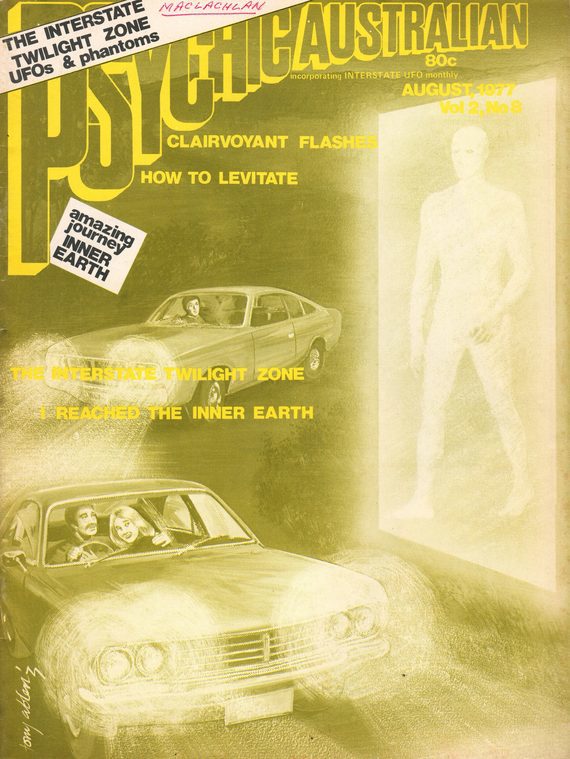
The original cover, credited in the issue to Tony Ablen, belongs to that history too. Its yellow and olive palette and strange roadside scene make a promise about the reading inside. The preserved hand-drawn artwork gives the reports another voice: someone had to decide how to depict a screen across a road, an impossible visitor or a vehicle concealed in cloud. Keeping those drawings alongside the words preserves something a plain transcription would miss.
Remembering Don Boyd
Don Boyd’s contribution deserves more than a name in the credits. A magazine needs someone willing to put an issue together, give writers space and keep a conversation going. The range of material in this one suggests an editor who was comfortable allowing very different approaches to sit beside each other. Chalker’s questions about what could be established share an issue with contributors who speak with much greater certainty about their own experiences.
Rex Gilroy’s later tribute gives a more personal sense of Boyd’s influence. Gilroy credited him with his first opportunity as a feature writer, remembered his helpful advice and described the encouragement that led him and Heather towards writing and publishing books. In the introduction to Australian UFOs: Through the Window of Time, Gilroy traced Boyd’s suggestion that he write an Australian UFO book to 1976.
He also remembered shared field trips and UFO watches in the Blue Mountains. Those recollections place Boyd within the world his magazines helped document. His legacy includes the encouragement he gave people who were still finding their way as writers and researchers. An editor can leave that sort of mark long after the individual issues have become difficult to find.
I wanted this recreation to acknowledge that generosity. The new layout is here to make the material accessible, while the original contributions retain their names and voices. Don Boyd and the people he published created the magazine. Bringing an issue back into circulation gives another audience the chance to discover their work.
A road through the Twilight Zone
If I had to choose one feature to introduce the issue, it would be Bill Chalker’s “The Interstate Twilight Zone.” It is rich in the sort of details that make an old account worth returning to: the shape of a light, an unexpected sound, a particular stretch of road and the witness’s attempt to make sense of it afterwards.
Chalker begins with a rectangular orange glow reported near Kimba in South Australia in February 1973. Four people travelling in three cars were involved, and two reportedly saw a white figure within the light. From there he moves through encounters in several states, including apparent presences in homes and ghost stories that surfaced during UFO investigations. He considers possible connections while keeping questions about the accounts’ reliability in view. In one particularly elaborate Canberra story, he explicitly says he had been unable to confirm what he had been told.
The Tasmanian incident is much shorter, and for me it is one of the issue’s most memorable passages. Here it is in Chalker’s original wording, from pages 10–11 of this recreated edition.
THESE STRANGE roadside manifestations may be setting a precedent which is getting harder to follow. But one man encountered something on his way home near Ten Mile Hill in Tasmania last year which may so far have been unique.
It was a wet August night and the man driving a Land Rover had just commenced the climb up the hill as the rain eased and finally cleared. Suddenly in front of the car a large yellow area "like a picture screen" appeared.
On the right hand side of the screen was a huge figure some three metres tall standing side on, and "as wide as three people." The "man" seemed to be wearing tight fitting clothing consisting of a black jacket and off-yellow trousers. No facial features were discerned but the figure seemed to have close-cut curly blond hair.
On the left of the screen was a dull yellow light. The figure seemed to turn towards the witness and simultaneously as the man braked to prevent an immanent collision a very loud "music" like "electronic music" turned up high flooded the still night.
The Land Rover seemed to pass straight through the screen and then there was nothing. The man turned back fearing he had knocked somebody over, but there was nothing but a deserted road.
Bill Chalker, “The Interstate Twilight Zone,” Psychic Australian, August 1977
What stays with me is the driver turning back. For all the impossibility of the screen and the figure, his response was familiar: he feared he might have hit someone. The account does not supply a name for the figure or an explanation for the music. It leaves us with a witness, an empty road and a few remarkably specific impressions. That is enough to make me want to read the rest.
Chalker makes a larger point later in the feature about the value of documenting such stories for future researchers and preserving them as folklore. That thought provides a good reason to revisit the magazine now. We are among the later readers for whom those accounts were kept. They can still prompt comparisons, questions and further reading, even where the original investigation reached no conclusion.
When the encounter follows you home
Another thread in Chalker’s feature feels particularly familiar to anyone who has followed the accounts surrounding Skinwalker Ranch. An encounter ends, the witness leaves, and something else begins. In later discussions of the ranch, the “hitchhiker effect” describes reports of unusual activity continuing around people after they return home. Chalker was collecting Australian accounts with strikingly similar sequences in 1977.
Near the end of his article, he describes a Victorian woman whose car stopped when an orange light came up behind her. She reportedly experienced a brief period of paralysis. Afterwards, she began seeing two apparitions on a number of occasions. One had clearly visible features and wore nineteenth-century clothing; the other remained indistinct, although she could still recognise it as an individual. Chalker does not say where these later appearances occurred, but the progression is remarkable: a light on the road, an interruption to her journey, then recurring figures in her life.
The North West Cape account takes the sequence directly into a house. A man identified as Mr Campbell reportedly watched a UFO passing low over the sea in 1967. That night, while at home thinking about what he had seen, he sensed a presence in the room. When he addressed it, he claimed a figure began forming in horizontal bands of blue and yellow light, then disappeared again. According to the account, two further presences appeared in his bedroom, and his wife began to stir. Campbell said they left after he asked them to go.
These are the passages I would particularly encourage readers to seek out. The Tasmanian screen encounter is extraordinary in itself, but these other reports raise a different question: what happens after someone thinks the experience is over? The resemblance to later Skinwalker accounts lies in that continuation, and in the way a UFO sighting can become entangled with apparitions and an apparent presence indoors. We cannot establish from these brief reports that the same thing was involved, or that something literally followed either witness. What we can see is that this unsettling pattern was already being described in an Australian magazine almost fifty years ago.
More than one kind of mystery
The issue’s other major features take the reader in different directions. Frank Lavery writes about learning to notice brief mental images that he had initially dismissed as imagination. One involved part of a sailing boat; the owner of the watch he was handling told him her uncle was building one. Lavery’s explanation is his own, but the interest lies partly in hearing him describe the uncertainty of those first impressions and the confidence he took from the response.
Borzak’s “I Reached the Inner Earth!” is considerably more extravagant. He describes meeting strangers while living near the Gold Coast, a craft hidden in a ground cloud and a journey that included an enormous shaft said to be in Tibet. His account goes on to discuss the inhabitants, climate and settlements of the world he believed he had visited. The setting begins close to familiar Australian homes before opening into a remarkable personal cosmology. It should be read as his claimed experience, in the words in which he chose to tell it.
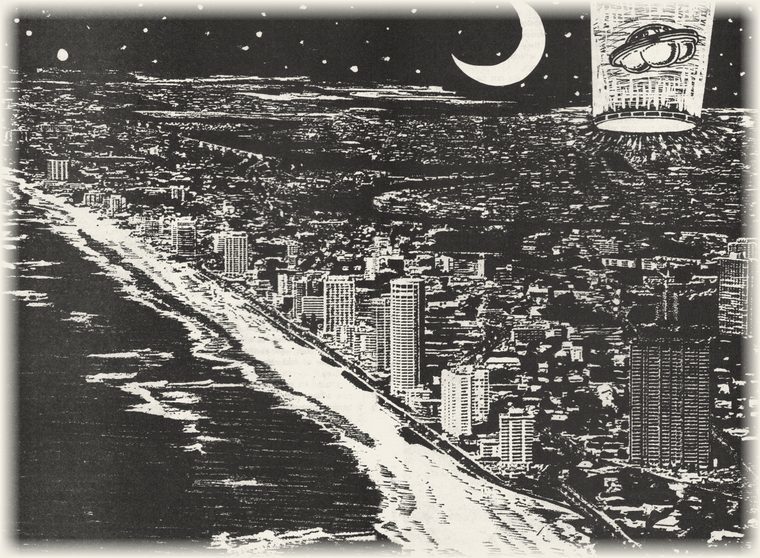
Reading across these contributions is part of the pleasure. The magazine did not have one explanation waiting for every unusual event. Its contributors brought different convictions and methods, and the resulting mixture gives the issue much of its energy. I wanted readers to have access to that variety rather than encounter only a few isolated highlights.
What this edition preserves
This is a recreated editorial edition made from surviving scans of the August 1977 magazine. It gives the original editorial text, photographs and drawings a new setting. Advertising, classifieds and routine publishing notices have been omitted, and articles that originally continued elsewhere in the magazine have been brought together. The introduction is new. It is therefore a newly arranged reading edition, rather than a page-for-page facsimile of the original issue.
The historical perspective remains part of it. These are the claims, arguments and expectations the contributors put into print at the time. I wanted to preserve the opportunity to read them closely, including the moments where a writer admits uncertainty or a reader challenges something in a previous issue. Those details help an old magazine remain interesting long after its news has ceased to be new.
My hope is that someone will come for the encounter on the Tasmanian road and stay for a writer they have not read before, a report from somewhere familiar or one of the issue’s more surprising arguments. That would be a fitting continuation of Don Boyd’s work: another reader finding something in the pages he helped bring into the world.
Download the full magazine
The full 30-page recreated editorial edition of Psychic Australian, August 1977, is available free below. Download the PDF to keep and read at your leisure, or open the magazine online at Internet Archive. It includes the preserved artwork and a new introduction honouring Don Boyd. The PDF is approximately 149 MB.
Further Reading
- Rex Gilroy’s Tribute to Don Boyd
- Colm Kelleher on the Hitchhiker Effect
- Australian UFOs: Through the Window of Time
Keep listening
Strange lights and unsettling encounters on lonely roads continue in 34.11, The Supernatural Highway, on the Mysterious Universe podcast. Join Mysterious Universe Plus at the Max tier to stream the episode and follow more of these stories through the available back catalogue.
Trending Podcasts
-
 36.13 I MU Podcasts
36.13 - MU Podcast - MU Interviews - Charlie Robinson - 002
-
-
 36.14 I MU Podcasts
36.14 - MU Podcast - The Tayos Caves Mystery Part 1
-
 36.16 I MU Podcasts
36.16 - MU Podcast - Beneath the Pyramids
-
 36.12 I MU Podcasts
36.12 - MU Podcast - The Skill Trap | Outsourcing Ourselves
-
Latest Articles
Rowan Ashford covers strange creatures, hauntings and local legends. He takes a particular interest in older reports and the details that disappear as stories pass from one teller to the next.
Previous article
Related Articles