

Nov 19, 2026 I Julian Vale
In a story passed on by his nephew, a soldier called Bob was patrolling an Arizona base in 1985 when an elderly man appeared. The guards challenged him. Their radio produced static. They looked away briefly; turning back, they found a large cottontail where the man had stood.
Then the man reappeared beyond a high, razor-wire-topped fence. Neither guard had seen him cross. The account leaves the base unnamed.
A rabbit makes an unlikely beginning to a military encounter story. Its presence would usually settle a disturbance rather than deepen it. Here, the animal occupied the very spot where the guards expected a person to be, while the person subsequently appeared somewhere they could not account for. The fence, which should have made the situation easier to understand, became the most troubling part of it.
Looking back through older accounts reveals encounters with a particular intimacy. These are stories about the short stretch of ground a guard can see, the doorway someone has just checked, or the sleeping quarters a soldier knows. The extraordinary arrives within a space that is supposed to be familiar and controlled.
The figure in the desert
Writer Brent Swancer collected a separate account from an unnamed White Sands Missile Range serviceman. On patrol, he and a partner approached a cloaked, elderly-looking figure who ignored their challenge. The figure dropped from sight in a flutter of fabric. A coyote ran past the guards. They could no longer find the man.
The resemblance to the Arizona story is immediate. In each account, a human figure disappears and an animal occupies the encounter in his place. The decisive instant slips from view: a glance at a radio, a sudden movement of a cloak. For the guards, the result was the same. Someone they had been approaching was gone, and the animal before them seemed bound up with that disappearance.
These are the moments that give shapeshifting accounts their peculiar power. The familiar outline of a person gives way to something else, leaving the witness trying to follow a presence that no longer seems confined to one form. In the desert stories, even the perimeter offers little reassurance. The boundary remains in place while the intruder seems to move beyond the guards’ understanding of it.
Over the weapons-store fence
At RAF Alconbury in Cambridgeshire, a former serviceman using the name Wes described a different sort of visitor. Posting his account on Nick Redfern’s blog in May 2007, he placed the encounter in 1970, when he was twenty and stationed at the base. He was in a secure weapons-storage area when he came upon something he could only describe as a werewolf.
His description was unusually specific: about five feet tall, muscular, with a flat snout, large eyes and a covering of hair. Wes said it seemed startled to have been discovered. He was carrying a .38 but never considered using it; he perceived no aggression. The creature fled on its hind legs, climbed a chain-link fence and disappeared into the woods. His fear subsequently developed into a desire to see it again. A few weeks later, he reported watching it briefly among the trees.
A further Alconbury encounter appears in John Hanson and Dawn Holloway’s Haunted Skies, revisited by researcher Tony Conn in 2024. Marc Uptergrove related his father Wesley’s account of a night in 1974. In this account, the senior guard responded to a radio report of an intruder and shots inside a fenced weapons area. A figure in the fog initially looked like one of his men. When he pulled alongside, it screamed into his face and fled.
Another guard fired as his dogs strained to get away from the creature. The animals’ terror gives this account a different character from Wes’s earlier recollection of a startled, apparently unaggressive visitor. Alconbury’s stories span more than one kind of confrontation: an unexpected meeting that drew a witness back to the woods, and a frightening pursuit in which guards and dogs struggled to respond to what had entered their ground.
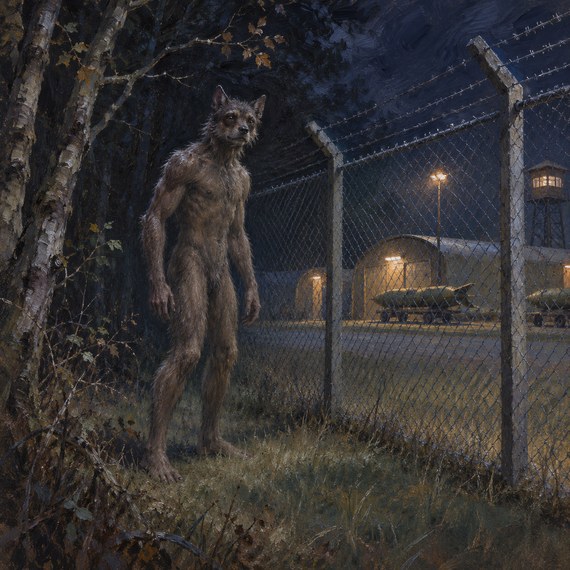
The movement across the perimeter links Alconbury with the desert accounts. These visitors seem at ease along boundaries that have a very different meaning to the men guarding them. An encounter can begin inside a weapons compound and end in the woods, with the fence left standing between the witness and something he now knows how to recognise, but still cannot explain.
Someone coming up the hill
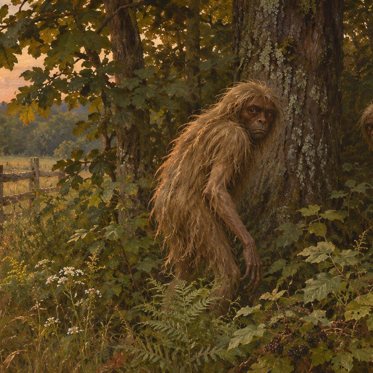
Four Marines training at Camp Pendleton in the autumn of 1968 reportedly faced that difficulty at much closer range. An anonymous participant submitted the story to the Bigfoot Field Researchers Organization in July 2001. The men had dug positions on a hill and were expecting a simulated attack. After midnight, they heard something ascending the rocky slope.
When it reached the crest, one Marine called for it to halt. The witness described an enormous upright silhouette only about six feet away, with a pointed head, broad shoulders and exceptionally long arms. In a later interview, he estimated its height at six to seven feet. Darkness concealed the details, including whether it was covered in hair.
The figure paused, then walked between the positions and continued down the other side. Investigator Kevin Withers recorded that the Marines had M-16s loaded with blanks. His follow-up also clarified the timing: the creature stood still for roughly fifteen seconds, while the entire observation lasted around a minute. According to the reporting witness, the four compared what they had seen and agreed to say nothing.
The four men’s agreement to remain silent is one of the most revealing parts of the account. They had compared their experiences with the people best placed to understand what had happened: the others who had been there. Beyond that small circle lay the prospect of having to explain an encounter that had already left them frightened and bewildered. Their silence carried the experience away from the training ground with them.
What followed the radioman
Nick Orton’s Vice feature brings these older encounters into conversation with the reports collected by Tales From the Grid Square. At Fort Campbell, one squad leader described a night position near the training town of Cassidy. The radioman had been moving between the soldiers, checking batteries. When footsteps approached again, the squad leader expected the same familiar visitor. Instead, he reported a growling figure crouched about twenty metres away, roughly five feet high even in that posture. He reached for his entrenching tool. As he lowered his night-vision equipment, it fled. Orton describes the view in Vice:
“Through the thermal optics, he could briefly make out its outline—something like a massive wolf.”
Orton had read the submitted accounts on Blurry Creatures in 2022. Another described a guard being grabbed beside a road culvert. His companion investigated, then saw an upright canine figure beyond the opposite opening. He estimated it at eight or nine feet, fired simulation rounds and said it dropped onto all fours and ran. Orton’s collection preserves these as encounters reported from the training area, with the same disturbing familiarity of footsteps giving way to something wholly unexpected. For the men on watch, the presence in the woods had come frighteningly close.
The man at every intersection
Another story featured in Vice can be followed back to a first-person submission published in Lethal Minds Journal. Its anonymous Air Force contributor placed the events at Kandahar Airfield in May 2010. After a ground attack, he saw a photograph of a dead man in white clothing with an arm missing. Later, during aerial surveillance of a suspected facilitator’s route, he repeatedly noticed a one-armed man in white at intersections.
The airman’s description was precise:
“every intersection I would see a one-armed man dressed in all white.”
They changed the sensor view to infrared. The figure appeared colder than the people nearby. A few days later, walking to work at about eight in the evening, the airman noticed someone standing in a concrete bunker. Looking closer, he saw that the motionless figure had one arm. He hurried away and told his colleagues, who laughed. Then his officer took him aside.
According to the airman, the officer reported seeing the same figure in a different bunker across the base. The airman said he never encountered it again, either directly or through the surveillance feed.
The soldier at the gate
On Okinawa, an older military legend gives its visitor a recognisable purpose. A figure in Second World War clothing approaches sentries at Camp Hansen’s Gate 3 and asks for a light for his cigarette. In its 2007 survey of Pacific-base hauntings, Stars and Stripes attributed the story to author Jayne A. Hitchcock. It is a quietly haunting image: a soldier returning to a sentry post with a request that would once have needed no explanation.
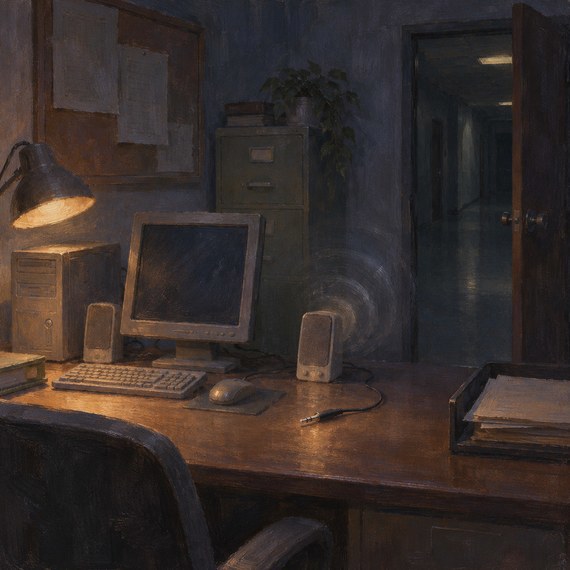
The same reporting offered a more personal account from Camp Zama in Japan. Specialist Jennifer Villagomez, a funds clerk working late at the chapel, said a Japanese male voice emerged from unplugged computer speakers. Its tone reminded her of a drill sergeant addressing a private. Suspecting a prank, she called for the sergeant elsewhere in the building. As he approached, she said, the voice diminished and stopped before he entered.
In both stories, the disturbing presence does something ordinary. One asks a favour; another sounds as though he is issuing instructions. Military life supplies the language of the encounter before supplying any explanation. A stranger at a gate can be challenged. A voice in an office can be investigated. The unease begins when those familiar responses fail to locate the person responsible.
Inside the building
The Army’s own magazine reporting contains similarly close encounters. Specialist Bradley Ehrhardt described waking in his room at Fort Riley’s McGill Hall around one in the morning in 1997. At the foot of his bed stood a figure more than six feet tall in a dark overcoat. It appeared shadowlike, though he could not see through it. Ehrhardt eventually asked it to leave him alone. He said it vanished and never returned to him.
The settings differ from a desert perimeter, but the encounter has moved only a little closer. The unexplained visitor is now beyond the fence and inside a building. A barracks room or workplace comes with its own expectations about who should be there. At night, the sound of another person can briefly be reassuring, until there is nobody to find.
There is something especially intimate about a presence that enters a serviceman’s sleeping quarters. Outside, a guard has a post, a sector to watch and companions nearby. Beside his own bed, Ehrhardt had only the figure before him and the words he eventually found to address it. His request was a simple one: to be left alone. In his account, the visitor answered by disappearing.
The rabbit offers perhaps the strangest resolution of all: an apparently harmless animal, followed by the return of the intruder. The confrontation has changed completely without bringing the guards any closer to understanding it.
Further Reading
- Military Bases and Supernatural Encounters
- The Alconbury Witness Account
- The Hard Stand Monster
- Camp Pendleton Encounter Report
- Haunted Places on Pacific Bases
- America’s Haunted Army
- Military Ghost Folklore
- Orton’s Earlier Fort Campbell Accounts
- The One-Armed Man
For more encounters in which appearances refuse to stay fixed, listen to 29.20 — Shadow of the Shapeshifters, exploring historical accounts and modern sightings of beings said to change form. Join Mysterious Universe Plus+ at the Max tier to stream this episode and explore the available back catalogue.
Trending Podcasts
-
 36.13 I MU Podcasts
36.13 - MU Podcast - MU Interviews - Charlie Robinson - 002
-
-
-
 36.14 I MU Podcasts
36.14 - MU Podcast - The Tayos Caves Mystery Part 1
-
 36.16 I MU Podcasts
36.16 - MU Podcast - Beneath the Pyramids
-
 36.19 I MU Podcasts
36.19 - MU Podcast - MU Interviews - Joshua Cutchin - 003

Elias Mercer writes about unexplained phenomena, unusual encounters and the stories that gather around mysterious places. His features connect contemporary reports with older accounts, exploring the details that make them worth remembering.
Previous article