




Sep 25, 2025 I Brent Swancer
Frederik van Eeden woke to the sound of a luggage box being blown along the landing. It was July 1906, and he was staying at Langen Schwalbach after a tiring day. The tremendous bumping ought to have brought the house to life. Instead, it alerted him to something he had learned to recognise. He was apparently awake in his bedroom, but the night had taken a familiar turn. On another apparent awakening he counted three windows in the room. He knew there should be two. When he deliberately woke himself, the extra window was gone. By his account, the house had been quiet all night.
Van Eeden described these episodes in his 1913 paper A Study of Dreams. He had spent years keeping records of experiences in which he could remember his waking life, make decisions and examine his surroundings while asleep. Some were beautiful. Others put him in a bedroom he recognised, with a wrongness he could feel before he found anything visibly out of place. He called that experience “wrong waking up.” Modern researchers use false awakening, a name that describes the discovery at the end rather better than the conviction at the beginning. For a few moments, or longer, the person has already got out of bed, resumed a task or looked around the room. Only afterwards does another awakening show where the body has been.
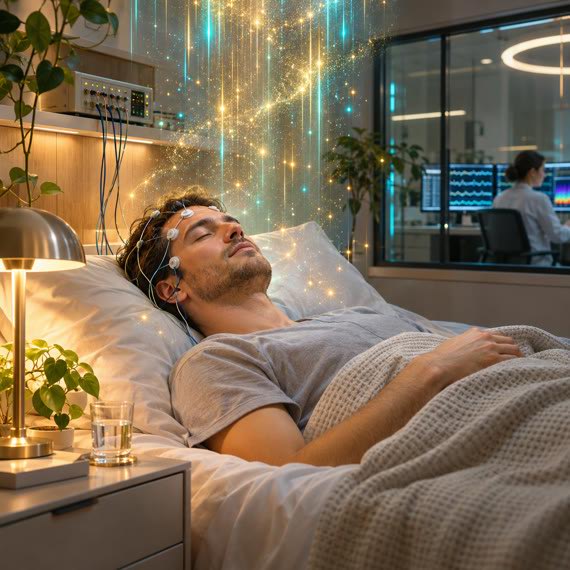
A 2025 study by Nerea L. Herrero and colleagues brings sleep recordings to this territory. Published in Scientific Reports on 29 September, it analysed ten episodes across seven participants, including lucid dreams, sleep paralysis, false awakenings and two out-of-body experiences from one person. Volunteers learned to signal awareness through agreed eye movements. Some episodes were identified through reports on awakening. Both out-of-body episodes differed from waking and light sleep in the reported EEG comparisons, while only one differed significantly from REM. The small exploratory sample records physiological activity associated with these experiences and leaves their wider meaning open. See the researchers’ original figure here.
The room with too many windows
The extra window was one of several occasions on which van Eeden found that waking up could be part of the adventure. In February 1899 he attempted a modest experiment during a lucid dream. He moistened a finger with saliva and drew a cross on his left palm. His intention was to see whether the mark would remain when he woke. What followed appeared to give him an answer. He woke, raised the palm to his cheek and felt the wet cross. Much later he woke again. He then understood that the hand of his sleeping body had been closed on his chest. Even the act of checking the result had taken place within sleep.
The detail makes the experience unusually easy to picture. There was no immense distance to travel and no unfamiliar landscape to interpret. A hand, a cheek and the dampness of a mark had been enough to make an apparent awakening convincing. Van Eeden could bring his purpose into the dream and remember the little test he had set himself. What he could not reliably do was recognise the moment when he had actually returned to bed. His awareness was keen enough to keep an experiment in mind, while the scene around that awareness could continue without announcing its change of status.
He had encountered a different version of the problem on the night of 19–20 January 1898. He dreamed that he was lying on his stomach in the garden, outside the windows of his study, watching his dog's eyes through the glass. At the same time, he recalled knowing that his body was in bed on its back. He decided to wake slowly and attend to the change. The sensation of lying on his front gave way to the sensation of lying on his back. Afterwards he remembered both positions. This was central to what he meant by a dream body: a body that could lie, look and move in one place while he retained some knowledge of another body resting elsewhere.
That distinction stayed with him when he used his voice. He could sing or shout with what seemed tremendous volume, then wake to learn from his wife that he had slept peacefully. The voice felt his own. So did the effort of producing it. He was repeatedly surprised that something so loud to him had left the waking room quiet. In his records, the bedroom could contain a sleeper who made little disturbance while an active version of the same person was elsewhere, calling out, flying or carrying out a small experiment.
The boy above the bed
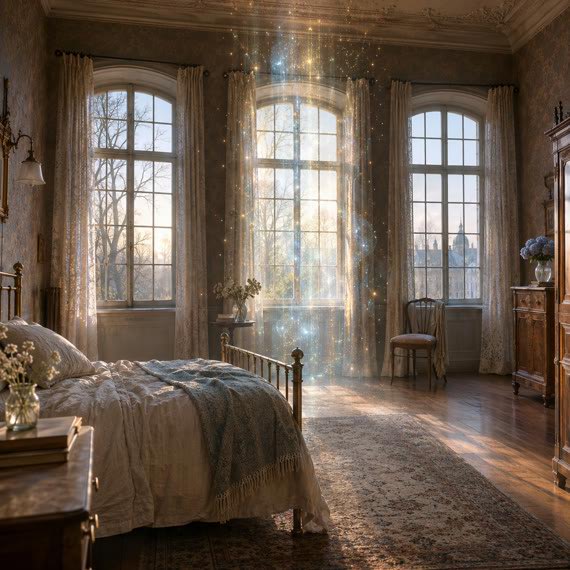
Sylvan Muldoon's account begins with almost the reverse difficulty. At twelve, he recalled, he had no clear idea where he was when awareness returned during the night. He was staying with his mother and younger brother in Clinton, Iowa, on a visit to the Mississippi Valley Spiritualists' Association camp. They had gone to bed in a house where several mediums were lodging. He remembered falling asleep at about half past ten, then eventually coming into a dark, powerless state in which he knew he existed but could not place himself. Gradually he understood that he was lying down. When he tried to move, he felt stuck to the surface beneath him.
In The Projection of the Astral Body, published with Hereward Carrington in 1929, Muldoon described a succession of sensations before the room came into view. The immobility gave way to floating, with rapid vibration and pressure at the back of his head. Familiar sounds began to reach him. Then he could see. In his recollection he was lying horizontally in the air above the bed and continuing to rise. At first he took the floating body to be his ordinary physical body. It seemed to him that the body he had always known was somehow being carried towards the ceiling.
He described being turned upright and placed on the floor, where he remained unable to move for a time. When the restraint eased, he stepped forward, felt a pull at the back of his head and managed to turn. Another version of himself lay on the bed. He also reported a cord joining the two bodies. The sight brought a frightening conclusion. He thought he had died in his sleep. What he wanted next was simple: to reach his family and make them understand that he was there.
Muldoon said he passed through a door while trying to open it. He went to the sleeping occupants, called to them and tried to shake them awake. His hands passed through them. He could see and hear, but the ordinary means of getting another person's attention had become useless. He recalled an automobile passing outside and a clock striking two. He moved about the rooms, hoping that morning would bring someone awake who could see him. Eventually the pull he associated with the cord became stronger, drawing him backwards towards the bed. He returned to a horizontal position above it and felt himself descend, ending with a sudden bodily jerk.
The account is remarkable for how domestic its concerns remain. Muldoon was in a house full of people and could reach none of them. The door offered no resistance, yet the problem of opening it had still occurred to him. He could go from room to room, but being able to move did little to relieve his fear. His account of freedom from the body begins with a child trying to wake his mother. Later he would organise these experiences into an elaborate understanding of astral travel. In this first remembered episode, his immediate need was to get back into contact.
Company on the other side of sleep
For van Eeden, recognising that he was still asleep sometimes opened into encounters rather than ending them. The night of the extra window continued through a series of lucid dreams. During one he was singing when a crowd of figures he called demons gathered and joined in. He described losing his composure and behaving extravagantly, throwing bedclothes and pillows about within the experience. One of the figures seemed less hostile than the rest and appeared to warn him about his behaviour. Following its advice, he formed a whip and threatened the gathering. The disturbance ended and the creatures withdrew.
His description belongs to a longer effort to distinguish different kinds of encounter during sleep. Some dream figures seemed mocking, others threatening. His own response could alter the course of the meeting. By the time he wrote the paper, the apparent awakenings that had once frightened him had become familiar enough to amuse him. That change did not make the extra window any less striking. It gave him a way to remain in an experience that had previously sent him struggling to wake. The night at Langen Schwalbach ended, he said, with him feeling cheerful and refreshed.
Muldoon also wrote of company during his reported journeys, although he cautioned readers against imagining that every departure from the body revealed a crowd of spirits. Often, in his telling, he found himself alone in familiar surroundings. He could carry ordinary habits into those surroundings. On one occasion he remembered stopping at a road to look for traffic, despite believing that vehicles could pass through him. The pause survived from everyday life. Elsewhere he described moving through people or objects without first thinking about the collision that a waking person would expect.
These small recognitions are part of what makes the old accounts worth returning to. Van Eeden could know he was dreaming and still accept an apparent awakening as the end of his test. Muldoon could believe himself beyond the reach of traffic and still stop at the kerb. Each retained a sense of being the person who had gone to bed. The curious part was how much of that person's habits, intentions and apprehensions could accompany him into a setting where the usual consequences no longer followed.
The laboratory work adds a different vantage point to such reports. For the participant there is the memory of the experience. For the researcher there is also a stretch of recording to examine alongside it. The study's eye signals offer moments when the sleeper can deliberately mark awareness for someone watching from outside. It is a striking counterpart to van Eeden singing while his wife heard nothing, or Muldoon calling to people who continued to sleep. A private experience can leave a small, agreed sign in the recording.
Van Eeden's wet cross remains perhaps the neatest account of how difficult that boundary can be to find from within. He had remembered his plan, carried it out and apparently woken to check his hand. Even the touch of his palm against his cheek seemed to settle the matter. Then he woke once more, with the hand still resting on his chest. The experiment had continued through the very moment he thought it had ended.
Further Reading
Herrero and colleagues on awareness during sleep
Frederik van Eeden’s A Study of Dreams
Muldoon and Carrington’s The Projection of the Astral Body
For more journeys beyond the sleeping body, episode 15.08 of the Mysterious Universe podcast ventures into tales of astral nightclubs and extraordinary returns from near death. Join Mysterious Universe Plus+ at the Max tier to stream this episode and the available back catalogue.
Trending Podcasts
-
 36.13 I MU Podcasts
36.13 - MU Podcast - MU Interviews - Charlie Robinson - 002
-
-
-
 36.14 I MU Podcasts
36.14 - MU Podcast - The Tayos Caves Mystery Part 1
-
 36.16 I MU Podcasts
36.16 - MU Podcast - Beneath the Pyramids
-
 36.19 I MU Podcasts
36.19 - MU Podcast - MU Interviews - Joshua Cutchin - 003
Rowan Ashford covers strange creatures, hauntings and local legends. He takes a particular interest in older reports and the details that disappear as stories pass from one teller to the next.
Previous article
Related Articles