
Nov 17, 2026 I Julian Vale
The woman sneezed, and the two small figures looked straight at her. Until then, she had been watching them move among the trees near her Pennsylvania farm. According to the account she gave researcher Stan Gordon, they were about three and a half feet tall, covered in straggly light-brown hair, and making sounds she compared to a baby's cooing. She thought they had been playing. Once their attention turned towards her, she ran into the house.
Gordon dated the encounter to 18 August 2026. The following evening, another woman in neighbouring Westmoreland County reported a short, hairy figure beside a rural road. She estimated it at five feet, with charcoal-grey hair and long arms. It ran uphill, briefly seemed to lose its balance and turned back. Gordon said he interviewed both women within an hour. Their encounters give Pennsylvania’s creature reports an intriguing turn: these figures were much smaller than the towering form usually associated with Bigfoot.
The smallness is the part that catches. An unfamiliar upright figure glimpsed among trees is disturbing enough without reaching the height of a door. Reduce it to the size of a child, put a second one beside it, and the scene changes. The witness is no longer describing something impressive chiefly because of its bulk. She is trying to account for a manner of movement, a shape, and the uneasy moment when it seems to notice her. The encounter becomes more intimate, while the familiar name attached to it becomes less useful.
Small figures open a different part of the mystery. Some witnesses think of a young Sasquatch; others reach for names from folklore, such as trolls. A creature’s size changes its impression without diminishing its strangeness. These accounts draw attention to gestures, movement and encounters between differently sized figures, suggesting more variety than the familiar image of an enormous, solitary beast.
Something crossing the path
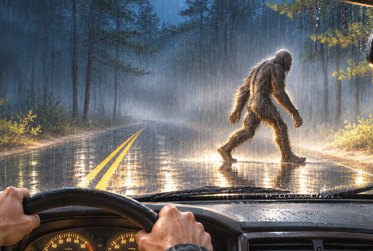
Nick Redfern recorded two encounters that move even farther from the familiar image. A couple he called Barry and Elaine described a winter night in 1975 near Slitting Mill, Staffordshire. Their car had stopped close to home when three hairy figures crossed the road. They estimated them at about four feet, with hunched backs and hooked noses, and called them trolls. The couple also described a troubling gap in their recollection before the car started again. Their account left both the creatures and the interruption unexplained.
Another man named Barry told Redfern of a summer encounter in New York's Central Park in 1997. A rusty-haired, man-shaped creature, little more than three feet tall, ran across a path about twenty feet ahead of him. It stopped briefly, looked at him and disappeared beneath a small bridge. Redfern interviewed him years later. Here no accompanying vehicle failure or memory gap was reported: just a small upright form in an emphatically urban park, and a witness embarrassed by what he said he had seen.
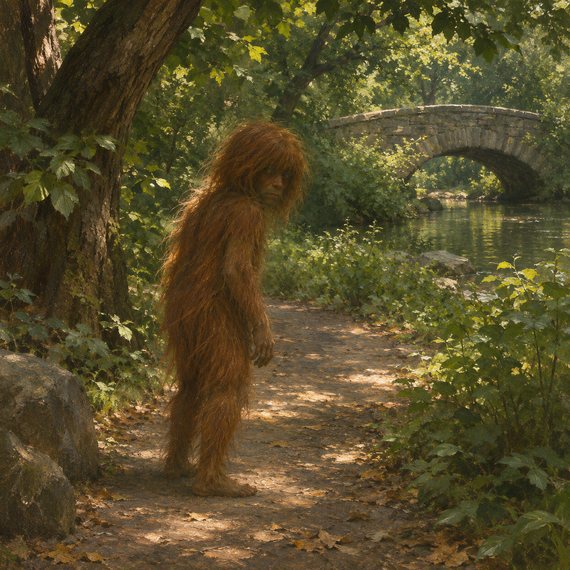
Trolls and young Sasquatch belong to different traditions, yet both offer ways to speak about a small, hairy figure with recognisably human features. The encounters retain an immediate quality: shapes crossing a road, a face turning towards a witness, a small body disappearing where nobody expected it. Folklore can feel unexpectedly close when something from its imagery appears during an ordinary journey.
Central Park gives the second encounter an uncanny setting. The creature disappeared beneath a small bridge in a place threaded with paths and human activity. Its presence seemed to open another layer of the park for the witness, suggesting something extraordinary could move through surroundings shared by countless people. A short walk brought him face to face with a figure more readily imagined in a remote wood.
The creature carried across the road
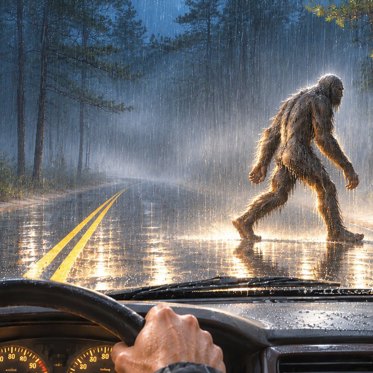
A much more elaborate report from Florida contains the kind of association missing from those encounters. In January 2012, a motorist exploring forest roads near Lake Mack became stuck in sand. In his submission to the Bigfoot Field Researchers Organization, he described being struck by a rock, hearing movement and hissing, and retreating into his car. A large, wet-haired creature eventually crossed the road. It later returned upright, carrying a much smaller hairy figure.
The witness estimated the smaller one at about three feet and described its lighter brown colouring. Initially it hung from the larger creature's hand by its arms. Across the road, the larger figure lifted it onto a hip; the little one then wrapped its legs around the carrier and clung to its chest. The man remained in his car until hunters helped free it. Investigator David Bakara later visited the site and found the place where the car had been stuck and a nearby water source.
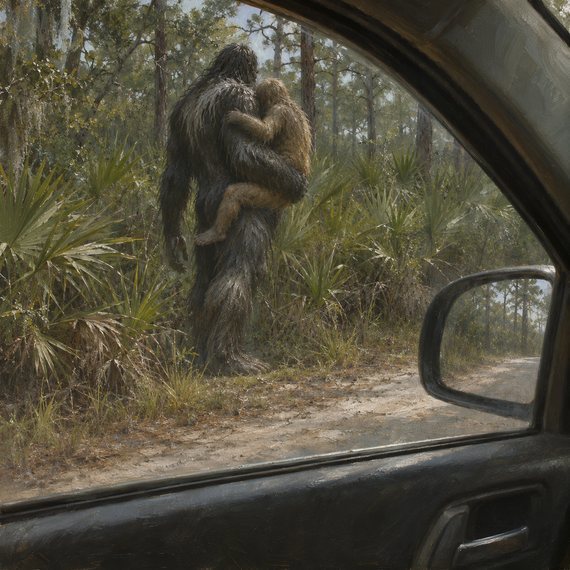
The carrying gives the scene an intimacy unlike a solitary creature crossing a road. The small figure’s clinging movement and the larger one’s adjustment of its hold are gestures a person can recognise. In the motorist’s telling, the pair seemed to have a relationship beyond their shared appearance. The forest had disclosed a glimpse of life within it, making the encounter more absorbing and no less frightening.
The second crossing gives the encounter a particularly memorable turn. A conventional monster encounter may end when the large creature disappears into the trees. In this account it came back. What changed was the witness's understanding of what might be in the scrub around him. A place he had entered alone seemed to contain more than one unfamiliar animal, including a small one he had not previously seen. The second crossing gave the first a possible context without making the situation any less frightening for the man watching through the window.
A small figure beside the rubbish
Another roadside report, this time near Spanaway in Washington, describes activity so mundane that it makes an odd companion to the Florida account. Two people driving to go fishing in May 2016 reported seeing an ape-like figure crouched beside discarded green rubbish bags. They watched an arm extend and drop material from a hand. Their account described a visible thumb and four fingers, black hair, and an estimated standing height of five and a half to six feet. They considered it a juvenile.
In Scott Taylor’s follow-up, the man’s girlfriend added that she had seen a larger figure in the forest behind it. The nearer creature crouched at roughly three feet; the witnesses estimated its standing height at five and a half to six feet. The presence among the trees gives the scene a depth the first glance might miss: one figure occupied with rubbish, another remaining farther back in the wood.
The roadside rubbish offers none of the grandeur of a remote mountain encounter. It is precisely the sort of place at which an animal might pause, and precisely the sort of unappealing detail that a polished legend might omit. Here it forms the centre of the observation. The witness watched a hand do something ordinary. The figure's identity remained extraordinary to him. For a few seconds, the distance between the familiar gesture and the unfamiliar body performing it became the whole encounter.
An animal nobody could name
The vocabulary remained more tentative in an Alberta report from April 2005. A woman and her thirteen-year-old daughter were travelling towards Edmonton when something crossed Highway 16 near Stony Plain. The mother compared its size and shape to a large chimpanzee and wondered whether an escaped animal was loose. She contacted a wildlife officer, who considered it a bear cub. She disagreed. In a later interview with BFRO investigator Blaine McMillan, she described a brownish-red animal running on all fours, apparently on folded hands rather than paws, and estimated it at about three feet at the shoulder.
The mother wondered whether she and her daughter had seen a young Sasquatch. They did not stop for prints, and no larger companion appeared. What remained was the animal’s movement across open ground, especially the impression of folded hands meeting the earth. The comparison with a chimpanzee captures how close it came to something recognisable while still leaving her searching for a name.
That search is part of the fascination. The mother tried to understand the animal through familiar wildlife, but a suggested bear cub did not fit her recollection. A young Sasquatch offered another possibility. The crossing opened a question she carried beyond the roadside, into a conversation with a wildlife officer and an interview with an investigator prepared to hear it.
Together, the encounters suggest more variety than the giant of popular imagery. Some figures appear alone, others in company; one is carried, another crouches beside bags, and another runs on folded hands. Their smallness draws attention to behaviour a towering silhouette might overshadow. These are glimpses of unfamiliar beings occupied with their surroundings, until an encounter with a person interrupts them.
A small creature need not make a small impression. The witness may be physically larger and still feel that the balance of the encounter has shifted against them. There is something especially disquieting about recognising a human gesture in a form that refuses an ordinary identification. The name offered later can make the story easier to tell. It cannot quite restore the confidence with which a person entered the wood, took the road, or stepped outside to finish a chore.
Further Reading
Yowie encounters and nature-spirit traditions take the story to the Australian bush in Mysterious Universe Plus+ episode 14.19. Become a Plus+ member at the Max tier to stream this episode and follow more unusual encounters through the available back catalogue.
Trending Podcasts
-
 36.13 I MU Podcasts
36.13 - MU Podcast - MU Interviews - Charlie Robinson - 002
-
-
 36.14 I MU Podcasts
36.14 - MU Podcast - The Tayos Caves Mystery Part 1
-
-
 36.16 I MU Podcasts
36.16 - MU Podcast - Beneath the Pyramids
-
 36.19 I MU Podcasts
36.19 - MU Podcast - MU Interviews 003 - Joshua Cutchin
Rowan Ashford covers strange creatures, hauntings and local legends. He takes a particular interest in older reports and the details that disappear as stories pass from one teller to the next.
Previous article