

Nov 14, 2026 I Julian Vale
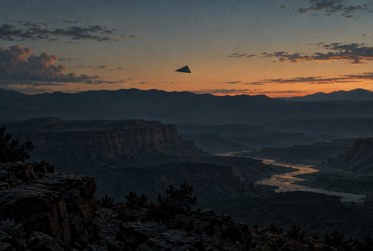
The girl came downstairs because her bedroom had filled with flashes of light. It was 9:14 on the evening of 25 August 2026 in Wilsonville, Oregon. Her mother had already reported something odd in the sky that night. Now the parents went upstairs and looked out the window. They said a large object hung in view for nearly a minute before vanishing. The girl had seen it before she called for them. When an investigator later asked her what it looked like, she described two large lights and a distorted silver surface that seemed almost transparent. She had taken a photograph while it was still there.
A little after eight, her mother had been out on the back patio when she saw something that appeared to fall abruptly. In her initial submission to the National UFO Reporting Center, she compared it to a bird dropping out of the air. It went from an apparent rectangle to a large ball and then a smaller one very quickly, and what looked at first like smoke streamed behind it. She called her partner and daughter’s attention to the sky. In that first account, they caught the trail. The later investigator’s notes describe the family watching the object together. The upstairs sighting had a clearer sequence. The girl called the adults, they came to the window, and she had a picture to show them.
The family’s account received wider coverage in November. The part I kept returning to came after both sightings. The mother told investigator Keith Bickford that she felt nauseated and had trouble with her balance. Her daughter said headaches came and went through the night. Both reportedly felt better the following day. The mother said neither had felt those symptoms before the sighting. After something strange has gone from view, there is usually little left for a witness to do except try to describe it. For these two there was also the question of how they were feeling, and how long it would last.
Bickford spoke to the mother four days after the events. He checked with two local farmers who used drones, and the two law enforcement agencies he contacted had received no UFO reports for that evening. He classified the sighting as anomalous. The symptoms appear in his summary of what the family told him. That is where the surviving account brings two things together: what they said they saw from the bedroom and what mother and daughter remembered about the hours that followed.
Heat on the road
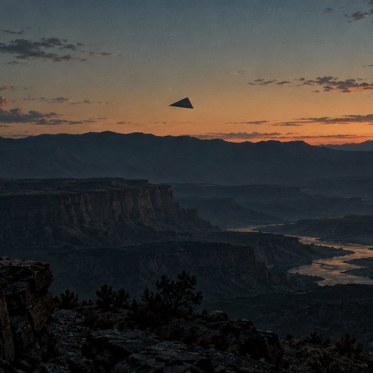
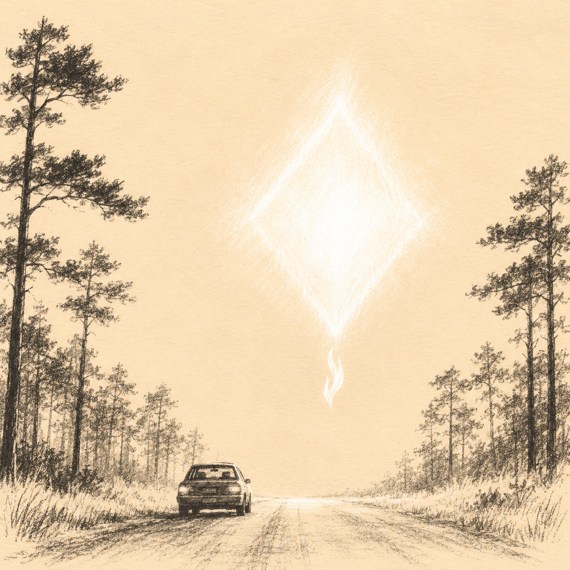
Betty Cash had a much more immediate sensation to describe when she sat down with Air Force representatives in August 1981. Eight months earlier, on 29 December 1980, she had been driving in east Texas with Vickie Landrum and Landrum’s seven-year-old grandson, Colby. They spoke of a powerful light over the road, then a shape in the glare. Cash compared its outline to a diamond. Flame or something that looked like flame came from below it. The way the witnesses told it, there was heat enough that they could feel it from the car.
Cash said she stepped out to look. Landrum had Colby to think about, and the boy was frightened. The three later described helicopters in the same stretch of sky. What stays with me in their interview is the change in the questions the women were asking. Out on the road the immediate problem was whether they could keep going and what was in front of them. By the time they sat before the Air Force interviewers, they wanted to know what had happened to them and where they could turn for help. The object had been gone for months. Its place in their lives had grown larger.
Cash told the interviewers she had become ill after the drive and had needed hospital care. She described skin problems and hair loss. Landrum described symptoms of her own and spoke about what she had observed in Colby. In his published account, investigator John F. Schuessler followed the three people through the encounter and its aftermath. One of the hardest details to shake is that they had all been on the same road in the same car, yet Cash described a much more severe course of illness. She had also spent more time outside. Those two facts sat next to each other in the story, giving investigators an obvious line of inquiry and the witnesses a reason to keep pressing for answers.
Later accounts often begin by calling this a radiation case. The interview starts in a different place. It starts with people describing heat, fear and the things they noticed in the days afterwards. The paperwork of the ensuing claim did not identify the object or establish an exposure responsible for their symptoms. In the transcript, Cash and Landrum are still speaking from the period before anyone knew what would become of their effort. Their concern about the object and their concern about their health are hard to pull apart, because for them the two had entered the story on the same drive home.
The pattern on his skin
On 20 May 1967, Stefan Michalak was prospecting near Falcon Lake in Manitoba. He said he saw two objects, one of which came down onto a rocky shelf. He approached it. In his account there was a part of the object that looked like a grille. When it moved, he said, a blast of hot air or gas struck him and set his shirt alight. The mystery he carried out of the woods included a pattern of marks on his abdomen.

Library and Archives Canada has gone back through Michalak’s own manuscript and the records left by the police and air force. Throughout those records there is a question that would have been impossible to ask if the encounter had ended at the moment the object went away. Could anything about the pattern of the marks be related to what he remembered seeing before he was burned? Michalak’s description of the object gave the marks a possible source. The marks in turn gave investigators something to consider alongside his description. The public record kept both in view, and the Canadian government’s Sky Canada report still includes the incident among the significant historical reports it surveys.
The difference between Falcon Lake and the Texas case begins with the position of the witness. Michalak said he had approached an object until he was close to it. Cash said she got out of a car to see what was over the road. In Wilsonville the family looked out from home. Their estimates put what they saw miles away, although they had little to measure its distance against. In Texas and Manitoba the witnesses described heat during the event itself. In the Oregon account the symptoms came into the report afterwards. Coming at these stories through the question of exposure means asking what that word could refer to in each place. A blast felt at close range is a different experience from an unexplained headache noticed after a light in the sky.
While the light was still there
Rupert and Reba Pring went into a field near Anderson, Indiana, in the early hours of 12 August 1981 to photograph a meteor shower. They were already watching the sky when, according to the account Schuessler collected, a light came down. Rupert described a sudden weight against his head and shoulders, as though a wet blanket had struck him. He said he could not move. In Schuessler’s later retelling, movement returned when the light withdrew. The catalogue cites a report published in Muncie the following January.
At Eggardon Hill in Dorset, on 24 September 1974, a driver reported seeing a blue ring of light with blurred edges rise into the sky. The headlights dimmed and the car would not accelerate. In the same brief interval, the driver felt cold. Schuessler’s account has the blue light zigzagging out of sight within about fifteen seconds, after which the car worked normally and the sensation passed. What makes these two entries worth reading beside Wilsonville is how precisely the witnesses placed the sensations in time. For Pring and the Dorset driver, the feeling ended with the light. In Oregon, the part of the story that mattered to the family continued into the night.
After the car stopped responding
On 6 March 1969, near Glenwood, Missouri, a woman reported driving into a shaft of light falling across the road from a hovering object. Her car slowed, and pressing the accelerator made no difference. She remembered the hair rising on her arms. Her dog tried to get under the seat. Schuessler records one detail that outlasted the encounter: her eyes bothered her for three days. The report moves from a car that would barely respond to a woman who could still feel something was wrong after she had left the road behind.
Five years later, near St Helens on Tasmania’s east coast, a woman was driving with two small children when static came through the radio. She reported a bright light in the sky, then the loss of the engine, lights, radio and heater. A vibration filled the car, and all three reportedly felt what they described as electric shocks. The woman later reported swelling in her arms and fingers and numbness on her right side. Schuessler drew both roadside accounts from a Center for UFO Studies collection on vehicle interference. Read for what happened inside the cars, they preserve a second set of observations: what the people felt as the equipment failed and what they still noticed afterwards.
What the witnesses felt first
Before dawn on 28 April 1966, Peter Rushton and Derek Robinson woke in a van near Sawtry, England. They reported struggling to breathe and noticing an acidic taste. Outside, birds were making a racket. When the men looked out, they said they saw two large spheres moving away. Schuessler drew the entry from a 1967 account in Flying Saucer Review. In the sequence he preserves, the two men felt something was wrong before they looked outside. By then the objects they described were already leaving.
The order was different for Denise Bishop. On 10 September 1981, she said she was walking up the steps of her parents’ home at Weston Mill Hill in Plymouth when she saw a large metallic-grey object with pink, purple and white lights. As she reached for the door, she said, a green beam struck her hand and she could no longer move. She told the story as a sequence she could follow: the beam drew back, she could move again, and later a mark appeared on her hand. Schuessler cites the Western Evening Herald, which published the account the following month.
A short entry from Middleton, Massachusetts, gives the light a different place in the witness’s memory. In June 1974, a woman reportedly saw a domed metallic object hover over her car. The radio filled with static, and a beam fell across the vehicle. What she remembered feeling in that moment was calm. It is a small entry in a catalogue full of pain, illness and fright, but it helps explain why Schuessler’s collection is worth reading case by case. A light might be the first thing one witness noticed and the last thing another saw. The sensation could be distressing, oddly peaceful, or something they only began to think about after it was over.
What the catalogue kept
Schuessler spent years collecting accounts in which the aftermath became part of the encounter. His 1996 catalogue gathered reports about skin, sight, balance, pain and other effects, drawing on sources that ranged from brief published accounts to more sustained investigations. The cases differ in how much anyone wrote down at the time. A few lines may preserve the only surviving mention of a symptom. A long account may still leave it unclear when someone first noticed it. Taken together, the reports show how much of the experience can happen outside the part of the story in which anybody is looking at the sky.
The catalogue turned up again in a defence-commissioned paper on reported effects on human tissue. Its appendix tabulated categories from Schuessler’s work, including headaches, nausea and burns. This is one of those moments when a strange collection of stories acquires a very different appearance. A witness’s description becomes an entry in a table. The table lets a reader see which complaints recur, while the original accounts let us see what was happening when each complaint first entered the story. The numbers are counts of reported effects in that collection. They come from people who had already described an extraordinary event and in many instances were trying to work out what else about that day belonged with it.
There is a final detail in the Oregon story worth keeping in its original proportions. The girl’s photograph catches something her family was trying to make sense of at the window. Everything we know about the headaches comes later, through what she and her mother told the investigator. By the next day, both felt better. For Cash the weeks that followed were much more difficult. Michalak left Falcon Lake with marks that became central to his account. Each witness had a different stretch of time to describe after the thing went out of sight. In Wilsonville, it was the rest of one night.
Further Reading
The Wilsonville Witness Report
Schuessler’s Catalogue of Reported Effects
The Defence Intelligence Paper
For another account in which an encounter lingered long after it ended, hear 32.11, Orb Headshot. Join Mysterious Universe Plus+ at the Max tier to stream the episode and explore the back catalogue.
Trending Podcasts
-
 36.13 I MU Podcasts
36.13 - MU Podcast - MU Interviews - Charlie Robinson - 002
-
-
 36.14 I MU Podcasts
36.14 - MU Podcast - The Tayos Caves Mystery Part 1
-
-
 36.16 I MU Podcasts
36.16 - MU Podcast - Beneath the Pyramids
-
 36.12 I MU Podcasts
36.12 - MU Podcast - The Skill Trap | Outsourcing Ourselves

Julian Vale writes about strange encounters, unexplained events and the mysteries of remote places. His features bring together eyewitness accounts and overlooked stories, following the connections between experiences separated by time and geography.
Previous article
Related Articles