Nov 13, 2026 I Rowan Ashford
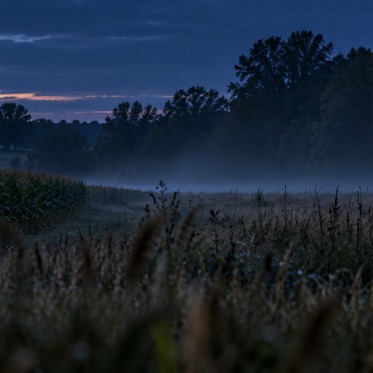
The object rose above the ridgeline without the sound the observers expected. It was late dusk, with the sun already down and enough light remaining to show a black triangular shape against the sky. Two federal law enforcement agents watched it from a distant observation position. They described a steady vertical ascent, a pause above the ridge and a rapid departure into a canyon drainage. Through the entire sequence, they reported hearing no engine, rotor or rush of displaced air.
Their account appears in a three-page All-domain Anomaly Resolution Office memorandum among the government UFO records released on October 23, 2026. The document is a witness debrief, preserving what the agents said they saw. Names, location and precise dates are redacted. Its significance lies in the unusually detailed sequence it records: the equipment the observers reached for, the terrain that bounded their view, the changing movement of the object and the absence of the noise they associated with aircraft.
That last detail gives the encounter an older and more familiar character. Long before the current UAP releases, witnesses were describing dark triangular forms that seemed to move too slowly, too low or too quietly for the machines they knew. Some appeared enormous. Others were comparatively compact. What repeatedly disturbed the observers was the mismatch between something visibly occupying the sky and the empty air reaching their ears.
In the 2026 debrief, the estimated wingspan was thirteen to fifteen feet. The agents described a matte, non-reflective surface, a broad triangular form and little apparent thickness. Their distance estimate, based on the surrounding terrain, placed it between approximately 1.4 and 3.2 miles away. The ridge gave the encounter a defined setting, with the dark shape rising into view against the surrounding country.
A third source had initially detected something with thermal equipment. The primary tripod-mounted system was facing east and could not immediately be brought onto the target. One agent took binoculars and a handheld thermal device; the other followed. These small practical details matter because they preserve the awkwardness of an unexpected observation. A sighting does not wait for equipment to be positioned, and the first moments can be spent trying to bring the right instrument to bear.
According to their reconstruction, the triangular object ascended for about ten seconds, rising an estimated two hundred to three hundred feet above the ridge. It then remained stationary for roughly twenty seconds. The witnesses reported no visible wobble, tilt or drift. The thermal appearance was described as broadly uniform, with no concentrated hot area corresponding to an engine and no visible exhaust trail. The outline remained recognisable while it hovered.
The agents described a fluid banking movement and a descent along the terrain, completed in approximately two or three seconds. One compared its speed to a fighter jet. The handheld thermal view lost the target, but visual observation continued until the landscape concealed it. After the steady rise and motionless pause, the sudden departure gave the witnesses little time to follow it into the canyon.
Afterwards, the observers had a fairly ordinary possibility to consider: perhaps something had come down beyond the ridge. A ground survey the following morning found no wreckage, scarring or damaged vegetation. During the encounter they had noticed no smoke or dust suggesting an impact. They also reported no interference with their equipment, unusual smell or physical effects. The account remains concentrated on the thing in the air and the brief opportunity to watch it.
A different view over Illinois
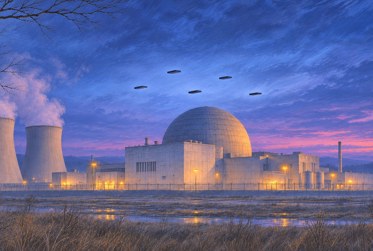
Twenty-six years earlier, police officers in southwestern Illinois had been trying to make sense of another unfamiliar aerial appearance. On January 5, 2000, an officer responding near Lebanon saw bright white lights which changed their arrangement as he approached. His early submission to the National UFO Reporting Center describes first two lights, then a merged light, then an elongated appearance. Only when the object passed almost overhead did he recognise what looked like a narrow triangle.
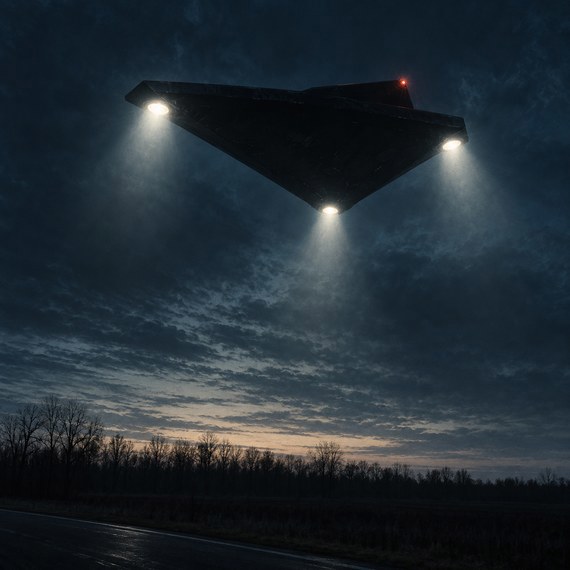
The officer stopped his car and switched it off. Three bright white lights pointed downwards; a red light blinked near the base, with further lights across the rear. It passed without audible noise and moved towards Shiloh. He alerted dispatch, which passed the observation to other departments. His submission, posted on January 7, puts the sighting at four or five minutes: time for the lights to resolve into an unfamiliar structure almost overhead.
At Millstadt, Officer Craig Stevens heard the reports over the radio and drove to look. His written account describes a large object travelling slowly at an estimated five hundred to a thousand feet, accompanied by a faint buzzing. He tried to photograph it with a cold Polaroid camera, then returned to the station to make a sketch and report. The encounter gave him an impression of immense presence with remarkably little sound.
There is something absorbing about the officers passing information across a working radio network. Each alert brought another person out to look, extending the encounter across roads and jurisdictions. The night’s ordinary police communications became a means of following an extraordinary visitor, with officers trying to keep it in view as it moved beyond one person’s reach and into another’s.
The Illinois sightings and the canyon encounter present different views of an angular craft. In one, powerful lights draw attention as an object passes almost overhead. In the other, a matte shape rises across a distant landscape. Both leave observers confronting an arresting combination of structure, movement and quiet. Something substantial enough to command the sky gives away little of how it is moving through it.
The reports that accumulated
The Illinois sightings became one of the cases investigated by the National Institute for Discovery Science. In April 2001, the private organisation published a broader survey of 127 triangular-object reports received through its hotline. Its category was deliberately broad, encompassing wedges, boomerangs and other angular forms. In 108 entries, the witnesses reported no sound. Seventy-five of the 123 reports containing speed estimates described hovering or very slow movement. The recurring stillness and quiet gave investigators a pattern to follow through the varied submissions.
The report's concern was unusually practical. Investigators drew attention to accounts of large objects near treetops or buildings, asking what such low flying might mean for people underneath. There were brightly lit objects as well as dark ones, faint sounds as well as silence. NIDS considered a military origin, but did not settle on an operator. Its tables preserve a varied collection whose differences are as useful as the resemblance suggested by the word triangle.
A witness estimating height at night often has little to work with. A tree, ridge or roofline can help place an appearance in the scene, but the object itself may have an unknown size. That uncertainty can become part of the encounter's peculiar force. Something seems both close and difficult to judge; its outline offers an impression of structure while withholding the everyday clues that would make distance and motion feel secure. A bright lamp can dominate the view, while a dark surface almost merges with the surrounding sky.
The canyon observers could place the object against recognisable terrain and follow it with thermal equipment. One agent compared its silence with smaller drones he had heard from the same hilltop at a shorter known range. Experience gave him a practical reason to find the quiet remarkable. The craft’s appearance was unusual, but the absence of an expected sound made it stranger still.
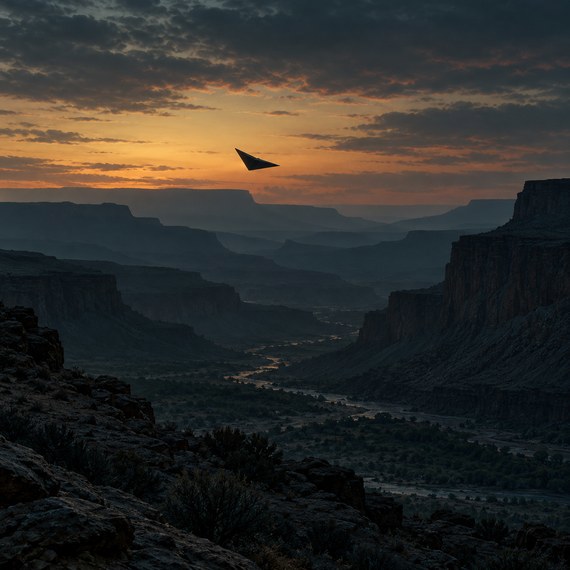
The redactions leave parts of the encounter hidden, while the central sequence remains vivid: a compact triangle rising above a ridge, pausing without visible drift and banking swiftly into a drainage. The agents watched closely enough to describe its surface and thermal appearance. Then the terrain closed around it, leaving a short, detailed account of an aircraft whose behaviour had resisted their expectations.
The lasting fascination of silent-aircraft reports comes from how little preparation they allow. A person looks up expecting the ordinary relationship between shape, movement and noise, and for a few seconds that relationship seems to fail. In Illinois, officers tried to follow the lights from one jurisdiction to another. In the canyon account, observers reached for instruments and watched a black shape slip behind terrain. The aircraft, whatever they were, passed out of view. The silence was what the witnesses kept describing.
Silence also changes the way a witness feels about distance. An aircraft can announce itself before it appears, its sound carrying over buildings or trees. In these accounts, the visual encounter seems to begin without that preparation. A substantial shape is already there, moving through the scene with little to draw attention to its arrival. The witness has to notice it, then decide what to do with the unfamiliar sight. The officers who stopped their cars and the agents who reached for instruments gave those brief opportunities their full attention. Their accounts preserve the effort to follow something that offered an outline and a movement while withholding many of the clues by which an aircraft normally becomes familiar.
Further Reading
- AARO witness debrief, 2026
- Low Flying Triangular Objects, April 2001
- Illinois officer report, January 2000
- Craig Stevens’s Millstadt report
Triangle sightings also feature in episode 3.01 of the Mysterious Universe podcast. Explore more encounters from the archive by joining Mysterious Universe Plus+ at the Max tier to stream this episode and the available back catalogue.
Trending Podcasts
-
 36.13 I MU Podcasts
36.13 - MU Podcast - MU Interviews - Charlie Robinson - 002
-
-
 36.14 I MU Podcasts
36.14 - MU Podcast - The Tayos Caves Mystery Part 1
-
-
 36.16 I MU Podcasts
36.16 - MU Podcast - Beneath the Pyramids
-
 36.12 I MU Podcasts
36.12 - MU Podcast - The Skill Trap | Outsourcing Ourselves

Julian Vale writes about strange encounters, unexplained events and the mysteries of remote places. His features bring together eyewitness accounts and overlooked stories, following the connections between experiences separated by time and geography.
Previous article
Related Articles