


Nov 18, 2026 I Elias Mercer
On Friday, 13 November 2026, an alert told American personnel at RAF Lakenheath to shelter in place. Sky News saw a copy of the message. The US Air Force said security forces had responded to suspected unauthorised drone activity and that no personnel, aircraft or infrastructure had been affected. The British Ministry of Defence said the situation had been resolved. Similar reports had come from several bases in England in November 2024, including Lakenheath. Long before either alert, when a call went between two Suffolk airfields on an August night in 1956, the people taking it had to work out what was passing over them with the help of a radar screen and whoever happened to be looking up.
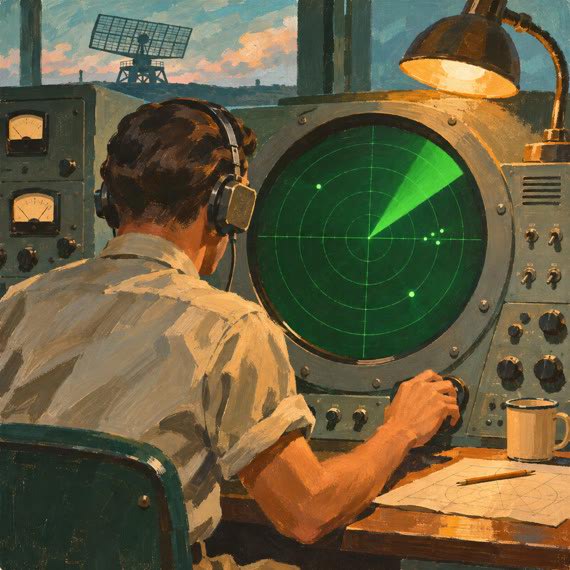
The call that mattered began at Bentwaters. One of the radar returns recorded there that evening appeared about thirty miles east of the station and moved west. It vanished on the approach to the field, reappeared on the other side and kept going. The estimate in the report put its speed somewhere between two and four thousand miles an hour. A controller could follow that movement as successive marks on a screen, but the tower had its own version of the crossing. Personnel there reported a bright light moving rapidly from east to west. There was a third view from a pilot already in the air, who reported a light streaking beneath his aircraft in the same direction. From one place it passed overhead. From another it passed below. On the scope there was a break in the track precisely where a witness on the ground might have expected the best view.
There had been other returns at Bentwaters on the night of 13 August. An intelligence report describes a group of roughly a dozen or more travelling from southwest of the field towards the northeast, much slower than the later westbound track. Another single return had already crossed on a different heading and at exceptionally high estimated speed. Set beside one another in a report, the three courses make for an eventful watch. They also make the westbound episode stand out. It was the one for which people in the tower and in the air supplied a description beyond the speed and direction of a mark. The radar staff contacted Lakenheath to ask whether anything unusual was showing there.
At Lakenheath the call sent people to their screens and out to watch the sky. Ground observers subsequently reported round white lights whose behaviour gave them a better description than their appearance did. One light was said to have stopped and changed course abruptly. Two lights were reported to have come together and gone out of sight in formation. The contemporary message distinguishes the
 times of these observations from some of the later radar activity. There were also enough shooting stars that night for the ground observers to remark on them. What stayed with the men at the screens, though, was the way some returns could hold a position and then travel again.
One track was followed from west of the base towards the southwest, where it was reported stationary for about five minutes. It moved again to the northwest and stopped a second time. Another return east of the station made a course the air traffic controllers described in terms of right angles. These were reports from men whose ordinary work made the movement of a conventional aircraft familiar. A light might look like little more than a point outside the building. Inside, the odd thing about the points was where they went. The most unsettling part of the night began when the RAF sent up a fighter and the controllers acquired two tracks they could compare.
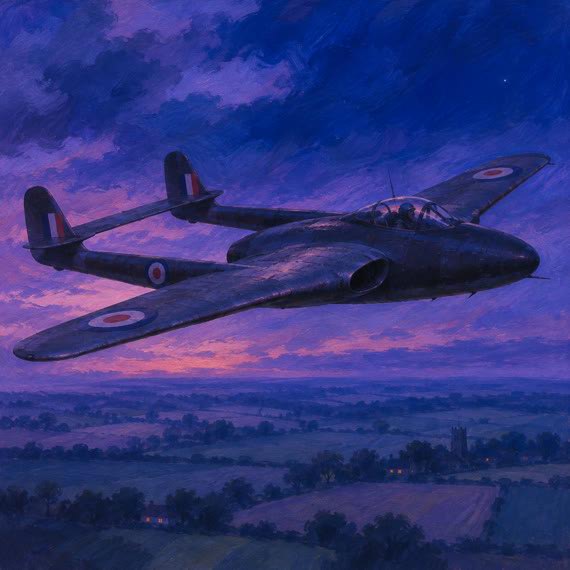
The Lakenheath message says the aircraft was believed to be a Venom, a British jet fighter with a twin-boom tail. In the contemporary account the pilot reported picking up a target on his radar. The ground controllers had their own returns, and the distinction matters for what followed. According to the message, the people watching on the ground saw the unknown return move into a position behind the fighter and follow its manoeuvres. What they were watching was a change in the relationship between two marks. The crew in the aircraft, hearing directions from the ground and working with its own equipment, had a different view of the same stretch of sky. There is no description of a recognisable airframe in that teletype, only the impression that something had turned an interception around.
Years later the former watch supervisor sent his account to the University of Colorado UFO study. By then he remembered the sequence more clearly than the date, and named the wrong station as the source of the initial call. He had held on to how close the return seemed to sit behind the interceptor and to how long the aircraft tried to shake it. To him the pursuit lasted about ten minutes. He remembered hearing
 the pilot's voice change as the manoeuvres continued. In his account the fighter eventually headed back and the return followed for a while, let it go and remained in the area. His sketch is worth seeing alongside the text. See the original sketch here.
In 1968, the Colorado investigators obtained copies of the Project Blue Book papers. The old message and the retired supervisor's letter had been written for utterly different purposes. One had to put a disorderly night into a form the Air Force could use. The other was an attempt to tell a group of researchers what had happened from the point of view of a man at a console. Putting the accounts together let the researchers recover the date and sort out which bases had called which. It also gave them two descriptions of the pursuit, one from close to the time and the other with the added detail of the operator's memory. When later accounts quote the pilot talking about his guns, that detail comes from the supervisor's recollection. The original message describes a radar lock in the pilot's report.
The aircrew recollections that surfaced decades later add another perspective. When Freddie Chambers spoke to David Clarke in 2001, he remembered going up with John Brady and being passed to Lakenheath control. In Chambers's recollection there was a scramble and the crew were directed towards a target, but his account does not contain the extended chase described by the men watching the ground radar. Another member of the squadron, Grahame Scofield, remembered discussing the interception with the crews after they came back. His letter names Chambers and Brady, and Ian Fraser-Ker and Ivan Logan. There is something recognisable about his memory of the men joking about the intercept back in the crew room. Whatever they had found above Suffolk, there was still the business of getting down, going back inside and telling the other crews what the call had been for.
A year after Lakenheath, an American B-47 crew reported an encounter in which the witnesses were all in the same aircraft and were still separated by what their jobs let them observe. A man at an electronic monitoring station in the rear picked up a powerful signal and suspected his equipment. He changed the range of frequencies he was monitoring. The pilots at the front subsequently described a bright light. The crew recalled receiving a range from ground control as well, at a position they understood to agree with what they were following from the air. The pilot brought the case to the Colorado project years later. Investigators found three of the officers closest to the event and heard how it had looked or registered at their different stations. Their recollections were more readily available than the records they said had been made during the flight.
The B-47 makes a good companion to Lakenheath because it helps explain why an event of this kind can be so vivid in the telling and still be difficult to put back together. The pilot of the American aircraft could see a light, while a man farther back was dealing with something turning up at a receiver. Both were occupied with what their part of the aircraft showed them. At Bentwaters a tower observer, a pilot and a controller could each supply part of a westbound crossing without any one of them being able to see what the others saw. When Gordon Thayer examined the Suffolk file for the Colorado study, he found the persistence and behaviour of the later radar track harder to account for than several of the earlier returns. His discussion focused on a particular stretch of the night, when an apparent target stopped, changed course and seemed to follow an aircraft sent up to meet it.
The 2026 shelter alert had a practical purpose and ended when the authorities judged that the immediate situation was resolved. The 1956 phone call had a practical purpose too. A controller had a track and needed to know whether the station down the line had anything like it. It is an ordinary beginning for the part of the story that still feels peculiar seventy years later. The man in the tower could look up and see a light go over the field. The pilot could look out and see one pass below him. In the room at Lakenheath, the men watching the interceptor could see something the crew itself had no good way to look back at. The fighter made for home, and on their screen the other mark stayed out there.
Further Reading
The 2024 reports over English air bases
Condon Report on the Suffolk radar sightings
The Lakenheath and Bentwaters case archive
Condon Report on the B-47 encounter
For another excursion into Suffolk’s high strangeness, the show notes for episode 20.11 of the Mysterious Universe podcast lead to the story of the glowing car of Rendlesham Forest. Join MU Max to stream the episode and explore the available back catalogue.
Trending Podcasts
-
 36.13 I MU Podcasts
36.13 - MU Podcast - MU Interviews - Charlie Robinson - 002
-
-
 36.14 I MU Podcasts
36.14 - MU Podcast - The Tayos Caves Mystery Part 1
-
-
 36.16 I MU Podcasts
36.16 - MU Podcast - Beneath the Pyramids
-
 36.19 I MU Podcasts
36.19 - MU Podcast - MU Interviews 003 - Joshua Cutchin
Julian Vale writes about strange encounters, unexplained events and the mysteries of remote places. His features bring together eyewitness accounts and overlooked stories, following the connections between experiences separated by time and geography.
Previous article