




Nov 11, 2026 I Rowan Ashford
One of the men who sat for Raymond Moody reached out to see whether he could touch the people he thought he saw. There were three of them, all relatives who had died. As Moody later recounted it, they seemed to come out of the mirror and gather around the chair. The man wondered whether someone had arranged a masquerade at his expense. He lifted his hand. It seemed to pass through them.
Moody recorded the encounter in a paper published in 1992. The man had come to sit in a psychomanteum, a room arranged around a mirror and the possibility of seeing someone who was gone. The mirror was angled to reflect darkness. From the chair, the visitor would ordinarily have nothing in it to recognise. For this man, the most surprising part of the session was that he ended up reaching into the space around him, where the figures seemed to have come to stand.
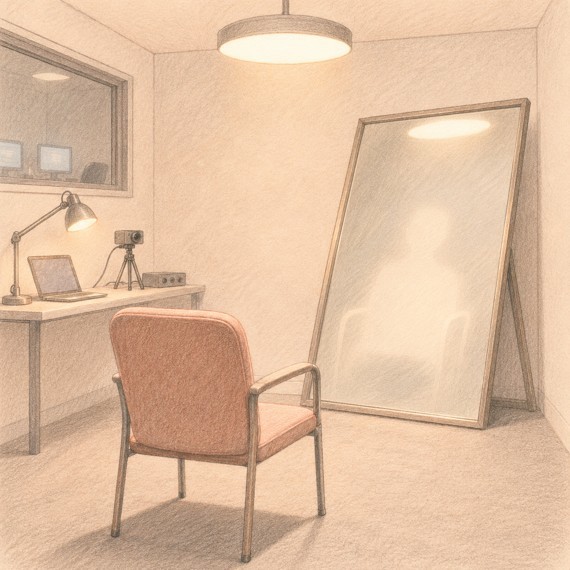
More than thirty years later, investigators at the University of West Georgia put a small keyboard beside the chair in a curtained mirror booth. Anyone who felt a presence or experienced strong visual imagery could mark the moment with a key press. The device gave the researchers a time to look for in their records. It also makes a peculiarly tangible detail in the story of those sessions. Somebody sitting alone in the dark could have the impression that another person was near and, without getting up or calling out, register the moment it happened.
A room with a place for someone else
Christine Simmonds-Moore and her colleagues recruited thirty people for the study, published in October 2026. All fifteen people in the comparison group had reported an earlier experience they interpreted as ghostly. In the group with synesthesia or synesthetic tendencies, the investigators relaxed that requirement when recruitment proved difficult. The distinction matters when reading the results: this was a small group selected for particular experiences and traits. Each spent fifteen minutes on an intention exercise before a forty-five-minute mirror-gazing session. An infrared camera recorded the area around the mirror. Afterwards, the participants were interviewed and completed a questionnaire about what they had experienced.
See the original photograph of the mirror chamber in Figure 1.
Twenty-four said on the questionnaire that they had sensed a presence. The investigators also worked through the transcripts for recurring themes. In that analysis, they coded presence in seventeen of the thirty sessions. The two counts come from different parts of the research. The questionnaire asked people to say whether they had felt someone there. Coding the transcripts was a way of tracking what emerged in the accounts they gave. Thirteen people in the synesthesia group and eleven in the other group reported a presence on the questionnaire. In this sample the difference between those groups could readily have occurred by chance.
There were more ways of feeling company than the word apparition suggests. The researchers found descriptions involving voices and odours as well as shadows and figures. Some people reported physical sensations or a change in the way the space felt. The paper also describes small bright specks in some infrared recordings. The researchers tried to reproduce them and found that moving the mirror could produce specks, although those were generally smaller and fainter. A speck on a recording and a person’s feeling that someone is near leave two very different kinds of record. Sessions with specks tended to contain more kinds of unusual experiences in the transcripts. The researchers compared recordings at the session level. A speck in one session still tells us little about what its occupant thought was sitting next to them.
It is tempting to imagine the session as a wait for something to become visible. Some of the reports read more like a spell of sitting alone that stopped feeling solitary. The mirror remained where it was, at one end of the booth. An experience might seem to come from beside the chair or from somewhere that a person could not point to at all. Earlier researchers had already found that people who came hoping to see a particular face sometimes took away a distinct impression of that person without seeing a face in the glass.
People who came to see someone
In research led by Arthur Hastings, twenty-seven volunteers sat in a chamber screened by dark theatrical curtains. A small night light gave it some illumination. Before sitting, a volunteer could talk about the person they wished to encounter and what they might say if given the chance. The researchers recorded several accounts in the participants’ own words. There was a woman who saw faces and robed figures and still felt that she had had no contact with the grandmother she came to see. And there was a man who felt that his sister had held him while he grieved, even though what stayed with him was chiefly a bodily sense of her presence.
The woman who had come for her grandmother had seen enough that her account might have looked impressive to someone counting images. She described shapes moving in the glass, including a dark revolving form, and appearances she could make out only in part. But she had come with someone specific in mind. The researchers recorded her session under no contact. In that circumstance, a face in the mirror could be less meaningful than the quiet certainty that the person she knew had come near.
A third participant hoped to see a friend who had died a few months earlier. She described a flash off to one side, above her, and a sense of receiving an answer inwardly. What she took from it was a rebuke for using the apparatus to seek her friend out, and a thought that she could turn instead to the friend’s sister, who was still alive. The account belongs in this story because its most memorable detail was a response the participant had not been looking for. She came to the room asking for a connection and left thinking about someone she could still go and see.
Hastings and his colleagues rated thirteen accounts as experiences of contact of varying kinds. None reached their category for a visual apparition with dialogue. That distinction makes the man Moody described reaching towards his relatives unusually vivid. Hastings’s volunteers could report a voice, warmth, a sense of touch or a feeling of knowing who was near. Their accounts give substance to a phrase like feeling a presence, which on its own can sound like a single, easily recognised event.
The faces people saw
Giovanni Caputo put the mirror to a different use. In his 2010 experiment, people looked at their own reflections in low light. Their faces remained the intended focus of the session. After ten minutes they described what they had seen. Some reported changes in their own features. Others thought that someone unfamiliar, a relative or even an animal face had appeared where theirs had been. The procedure gave them a familiar image against which they could notice every change. At the end, some had a harder time recognising themselves than they had at the beginning.
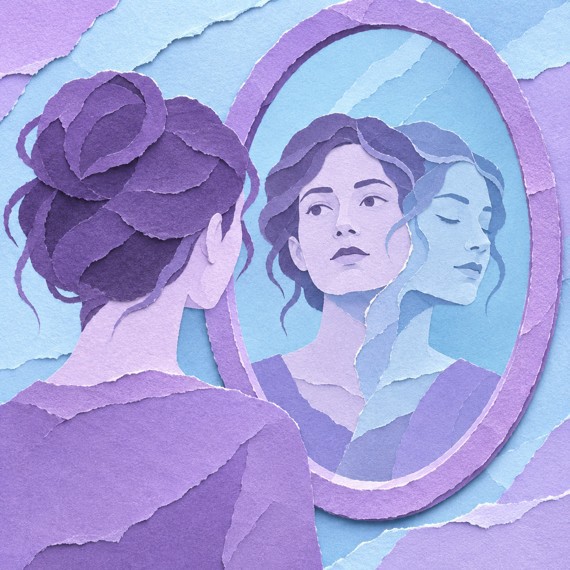
There is a difference between an experiment that directs attention to one’s own reflected face and a room arranged to keep that reflection out of view. Caputo’s participants were looking directly at a face capable of seeming to change. Moody’s visitors were looking into a surface that was supposed to reflect an unlit part of the room. A person who sees an unfamiliar face in the first setting can say where it appeared with some precision. Someone who feels a relative sitting nearby in the second may have little to show on the surface of the glass. The two situations tell us something about the kinds of reports the word mirror can hold.
Moody’s own account takes the story farther from the glass. He had prepared to see his maternal grandmother. The person he later thought he met, in a different place after leaving the psychomanteum, was his father’s mother. He wrote that a woman came into the room and seemed familiar. Recognition came only after he had spoken with her for a time. He also described a journalist who reported seeing her son during her session and then again at her motel that night. Her account of the second encounter begins with a locked door and the momentary belief that a stranger had somehow got inside.
Those were the stories Moody chose to write down decades ago. The new study gives that older reporting a useful counterpart. Its participants could identify a moment with a button or describe it later to a researcher. The figures in the final paper allow a reader to follow how people reported their experiences in different ways. They cannot tell us what it meant to hear a voice that sounded like someone we had once known well, or to see a figure and need time to recognise it. For that we still have to go back to the words of the people who sat in the chair. What someone came hoping to see, where they were looking, and what they felt had happened to them could turn out to be three different things.
Further Reading
Raymond Moody’s Mirror Room Accounts
The Hastings Bereavement Study
Giovanni Caputo’s Strange Face Experiment
For more stories of presences and farewells, try episode 19.20 of Mysterious Universe Plus+, whose show notes bring together accounts of crisis apparitions and encounters with departed loved ones. Join at the Max tier to stream the episode and the available back catalogue.
Trending Podcasts
-
 36.13 I MU Podcasts
36.13 - MU Podcast - MU Interviews - Charlie Robinson - 002
-
-
 36.14 I MU Podcasts
36.14 - MU Podcast - The Tayos Caves Mystery Part 1
-
-
 36.16 I MU Podcasts
36.16 - MU Podcast - Beneath the Pyramids
-
 36.12 I MU Podcasts
36.12 - MU Podcast - The Skill Trap | Outsourcing Ourselves
Rowan Ashford covers strange creatures, hauntings and local legends. He takes a particular interest in older reports and the details that disappear as stories pass from one teller to the next.
Previous article
Related Articles