Nov 18, 2026 I Elias Mercer
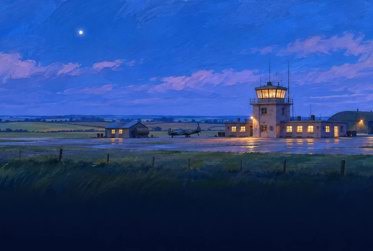
For a few hours, there seemed to be a town where there should have been forest. People watching from Kings Tableland reportedly saw a mass of lights appear in the country beyond the Jamison Valley, then disappear before morning. Rex Gilroy called it the “phantom city”. Elsewhere in the same region, campers described a sound like machinery working beneath the ground.
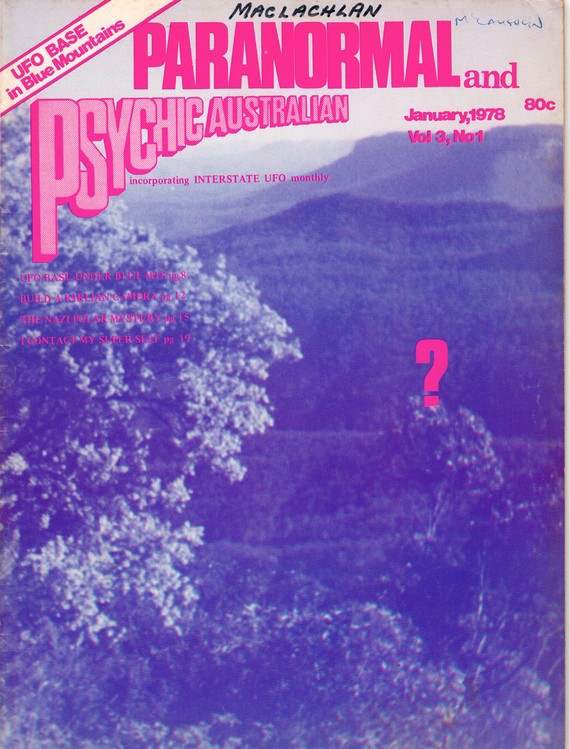
Those reports form the centre of “UFO Base under Blue Mountains”, one of the major features in the January 1978 issue of Paranormal and Psychic Australian. Following our return to the August 1977 edition, this is the next issue I wanted to share. Its bright pink cover lettering and violet mountains introduce a collection of stories that ranges from a glowing craft in a bush clearing to a Melbourne writer’s unsettling encounter with what he considered his own higher mind.
We are sharing the complete 35-page recreated editorial edition of the January 1978 magazine as a free PDF. It brings together the original articles, photographs and artwork in a renewed layout, with a new introduction honouring publisher and editor Don Boyd. Period advertising and publishing notices have been omitted. Download the full January 1978 magazine here or read it online at Internet Archive.
A valley with something happening underneath it
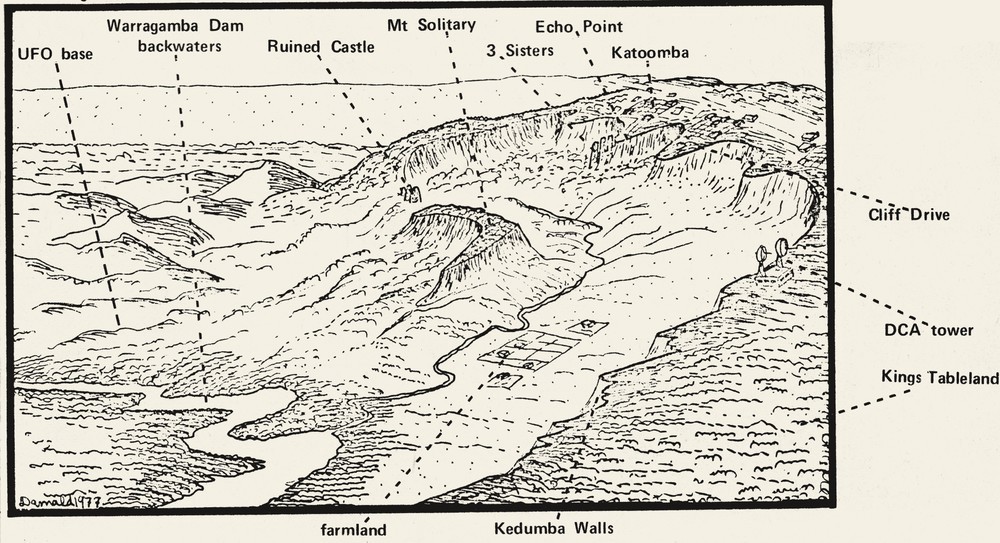
The strongest part of Gilroy’s feature is its accumulation of local detail. Kings Tableland, Mount Solitary, the Warragamba Dam backwaters and the Burragorang district recur as witnesses describe objects crossing the sky, descending towards the trees or apparently disappearing into remote country. A reader can follow the place names on the magazine’s hand-drawn diagram and see how Gilroy assembled his picture of an unusually active landscape.
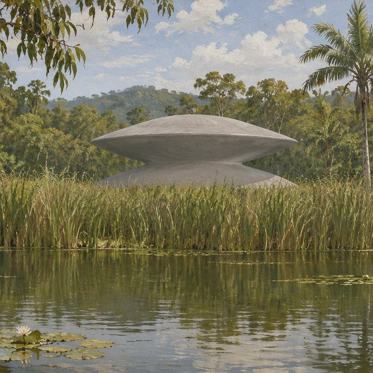
He describes a young couple driving towards Wentworth Falls along the Kings Tableland road one night in 1971. They reportedly found themselves being followed by a saucer-shaped object giving off a green glow and a humming sound. They estimated its width at about twenty-five feet. According to the account, it passed over their car, travelled ahead of them at roughly thirty feet above the ground, then rose and vanished. Gilroy says people watching from Cliff Drive, across the valley at Katoomba, also saw a green object in the distance.
Other reports took the activity lower still. Residents of farms below Mount Solitary described strange craft flying overhead as though coming in to land, then disappearing towards the country south of the dam backwaters. These were the accounts that led Gilroy to wonder whether the destination mattered as much as the objects themselves. What was out there, beyond the last familiar landmark?
The report of seven campers gives that question an unusually physical form. Gilroy places it in the months before his article appeared, without supplying an exact date. The group had settled for the night when they heard a throbbing and grinding noise that seemed to come from beneath them. It grew louder, and they said the ground began to vibrate. They got up with their torches and searched in the dark, but found no explanation. The noise continued well into the night. Another search in daylight was equally unsuccessful, and they left the area.
The sound seemed to belong to machinery, but its source remained hidden beneath the campers’ feet. Gilroy linked their experience with lights and descending craft reported in the district, developing the possibility of an underground extraterrestrial base. His interpretation gives the vibrating ground a much larger setting: a campsite becomes the surface of somewhere that might hold an activity utterly unfamiliar to the people trying to sleep above it.
The camper who followed the humming
One of the issue’s best short encounters concerns a man identified only as Mr Weston. In 1971, he was reportedly camping in remote country south of the Warragamba Dam backwaters when a loud humming woke him. He took his torch and went to investigate. Ahead, he could see white light illuminating the scrub around a clearing.
Here is the central passage in Gilroy’s original wording, from page 15 of the recreated edition:
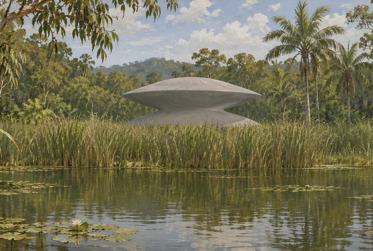
As he approached the clearing, he could see through the trees that the glow was coming from some strange structure which he thought to be somewhat egg-shaped. Dark man-like figures appeared to be moving hastily about the craft.
Mr Weston wondered whether to approach the figures to enquire what was going on. As he stood there among the trees, the figures disappeared into the object and the glow suddenly faded, the mysterious dark shape rose into the air, its loud humming noise now silent.
Mr Weston returned rather hastily to his camp and unable to sleep after what he had witnessed, he remained awake until morning when he packed his haversack and wasted no time in leaving the valley.
Rex Gilroy, “UFO Base under Blue Mountains,” Paranormal and Psychic Australian, January 1978
Weston’s impulse to ask the figures what they were doing is one of the story’s most arresting details. For a moment, the unfamiliar craft still seemed to offer an ordinary conversation. Before he could decide, the figures had withdrawn and the object was leaving. His haste to abandon the valley conveys how completely the encounter had changed his feelings about the place where he had camped.
The phantom city expands the mystery across the landscape. Gilroy describes observers at the far end of Kings Tableland watching lights resembling a town appear and vanish before morning. In his telling, the country associated with strange sounds and descending craft had briefly acquired a settlement of its own. It is an extraordinary image: a familiar valley holding the lights of somewhere that would be gone by daylight.
The mountain that would not rumble on demand
A quieter connection waits in the letters pages. Mike Kelly of Corinda, Queensland, wrote about stories he had collected while visiting the Monto district in 1972. His letter moves through reports of an elusive animal, unusual lights, curious holes and a mountain that sometimes rumbled without an obvious cause. Beside Gilroy’s Blue Mountains feature, it becomes an intriguing second account of people trying to understand sounds coming from the landscape.
Kelly identified the mountain as Mount Tellebang, south of Monto. A nearby farmer told him a university geological team had examined it without finding a conventional explanation for the rumbling. Kelly thought it had remained silent during their visit. The local account captures a familiar frustration in pursuing strange phenomena: a disturbance becomes part of people’s experience of a place, yet remains elusive when others arrive hoping to encounter it.
His letter is valuable partly because he says what he does and does not know. He had heard of UFO sightings without recalling a conversation with an actual witness. Reports of strange caves were vague, and he could not explain what made them strange. A grazier whose property contained a supposed Bunyip Hole said nothing unusual had happened there for decades and allowed his children to swim in it. Kelly preserved that uneventful detail alongside the more sensational stories.
He also described the difficulty of asking questions as a stranger. Some residents thought he was being foolish; others apparently suspected he wanted to make fools of them. His proposed solution was to invite accounts through country newspaper advertisements before visiting. The editor’s response explained that contributors already made extensive use of local papers and offered Kelly space for a longer article.
That exchange is one reason to share the whole issue. Readers can follow the work behind the stories: asking around, finding people willing to speak and searching for a way into experiences that seldom arrive on demand. The Blue Mountains and Monto reports give the magazine a sense of an Australian landscape with more happening within it than a visitor might suspect from the view alone.
What else was happening in January 1978?
The news pages make the magazine feel especially close to its time. At Leitchville in Victoria, farmer Tom Church reportedly found a thirty-foot burned circle in a recently cut clover paddock after working there the previous day. UFO investigator Paul Norman examined the site and interviewed people in the surrounding district. Nearby reports included unusual lights, other circular marks and a milk-tanker driver who watched a red light change height before moving low across the ground.
These items are brief, but they preserve the names, occupations and small circumstances that tend to vanish in later summaries. A train crew near Molong described a bright, descending object with square windows around its circumference. Two Lands Department officers in the Wimmera reported a large black cat sitting against a white sandhill before moving into the scrub. The magazine placed such accounts alongside film news, readers’ disputes and a visit to a North Sydney workshop where Helmut Fischer made very tangible monsters for television.
Frank Lavery’s contributions take the reader somewhere more personal. In “I Contact my Super-Self!” he describes an effort to stop smoking and practise meditation that culminated in a brief, disconcerting change in his sense of identity. Walking to work in Melbourne, he felt separated from his body and thoughts, looking through his eyes as though they were an instrument. He interpreted the experience through his spiritualist understanding of higher and lower minds. It is his own account of that experience, and of the meaning he took from it.
His short “Fantastic Journeys” column is stranger still. Lavery describes becoming fully aware while drifting towards sleep and seeing a white sphere through the bedroom wall. A hatch opened, a flash of light immobilised him, and he felt himself drawn out of his body into a tiny compartment. His awareness then faded, leaving him unable to say where he had been taken or why. Read beside Gilroy’s clearing in the bush, it is another encounter in which a mysterious vehicle appears briefly and leaves its witness with more questions than answers.
Another issue worth keeping
I wanted this follow-up to offer a different route into Don Boyd’s magazine. The August issue gave us Chalker’s encounters on roads and in homes. January’s most compelling thread runs through the landscape: lights beyond a lookout, a sound under a campsite, a mountain whose rumbling was known locally but difficult to investigate. The letters and smaller reports give those longer features company and context.
Boyd’s contribution was to give that variety a place to appear together. Rex Gilroy later remembered his encouragement as a writer and their shared expeditions in the Blue Mountains. It seems fitting to revisit an issue in which that country occupies so much space. Preserving the photographs, maps and original bylines lets readers return to the material at their own pace, rather than rely on what a later retelling happens to retain.
The recreation keeps the original editorial writing and artwork while arranging it for comfortable reading. The introduction and tribute to Boyd are new; the historical articles retain the ideas and language of their time. My hope is that the phantom city will bring readers to the issue, and that something less expected in the letters, news or first-person accounts will persuade them to keep it.
Download the full January 1978 magazine
The complete 35-page recreated editorial edition is available free below. It contains the full features discussed here, the letters, news reports, photographs and original artwork, with period advertising and publishing notices omitted. The PDF is approximately 81 MB.
Further Reading
Keep listening
For more Australian UFO encounters, episode 12.04 of the Mysterious Universe podcast features Damien Nott, while its Plus+ extension lists Rex Gilroy’s Blue Mountains Triangle among the material discussed. Join Mysterious Universe Plus at the Max tier to stream the episode and explore the available back catalogue.
Trending Podcasts
-
 36.13 I MU Podcasts
36.13 - MU Podcast - MU Interviews - Charlie Robinson - 002
-
-
-
 36.14 I MU Podcasts
36.14 - MU Podcast - The Tayos Caves Mystery Part 1
-
 36.16 I MU Podcasts
36.16 - MU Podcast - Beneath the Pyramids
-
 36.19 I MU Podcasts
36.19 - MU Podcast - MU Interviews - Joshua Cutchin - 003
Rowan Ashford covers strange creatures, hauntings and local legends. He takes a particular interest in older reports and the details that disappear as stories pass from one teller to the next.
Previous article