

Nov 19, 2026 I Rowan Ashford
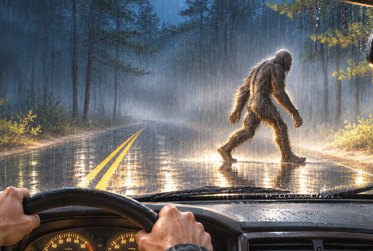
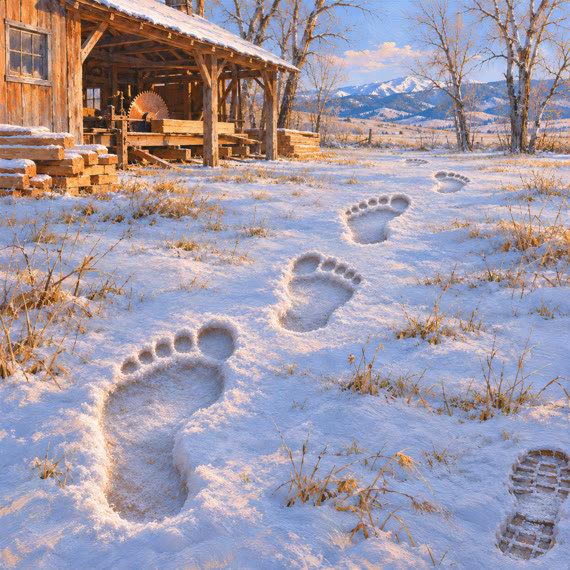
When eight year old Austin Petersen and his father visited their neighbour’s Montana sawmill in January 2003, they found something that brought the surrounding woods uncomfortably close. Hundreds of large footprints marked the snow around Jim Rohweder’s property on River Road West. Neighbours described impressions sixteen and a half inches long, with an average stride of five feet. Earlier that morning, Dean Petersen had heard his dog barking and seen the workshop’s motion light shining. He had looked outside and seen nothing.
The tracks led into trees, where the snow thinned and the ground became difficult to read. There was another memory attached to the property. Jim’s wife, Gladys, said she had seen a hairy, two-legged creature when they first moved there, around thirty years earlier. Now something had apparently walked through their familiar surroundings again, leaving a trail for the neighbours to follow.
That newspaper clipping is among three historical records the United States Forest Service placed in its public reading room on 15 October 2026. Together they lead from a residential yard to a hunting ground and a protected watershed, preserving several very different encounters with the Bigfoot question. Their publication offers an opportunity to return to the people, places and unsettling details inside them.
A mystery already close to home
The release arrived in a month when another branch of the Forest Service was making room for people to discuss precisely this subject. Stanislaus National Forest hosted a presentation called Bigfoot in Your Backyard. An announcement later described an audience so large that some people had to be turned away, and directed those who missed it to a recording made available by Access Tuolumne. The programme included historical accounts, alleged sightings, footprints, recordings and experiences shared by audience members.
The local setting matters. The announcement pointed to encounters along Highway 108 and traditions concerning giants around Table Mountain and Columbia. For people living in those communities, the subject belongs to roads, wooded slopes and places with familiar names. The recording can be watched through Access Tuolumne’s Bigfoot presentation page.
One older report from the same county provides a particularly vivid connection. In January 1963, a search party led by Sheriff Miller Sardella examined unusually large tracks below Cold Springs, near cabins and campgrounds. A contemporary Union Democrat report, preserved in the Bigfoot Field Researchers Organization’s archive, described accounts of a very tall figure and repeated shrieking. Reserve Deputy Elbert Miller had lost a trail among cabins in the Jenness Park area; officers returned and found more impressions.
The report also preserves differences between the observers. Sardella described the marks as shoe prints and suggested that fresh mountain lion tracks might help explain the noises. Miller had compared the sounds with a mountain lion’s cry while maintaining that what he heard was different. The episode retains that unresolved human texture, with several people looking at the same woods and coming away with different impressions of what had happened there.
Hunters following something they never saw
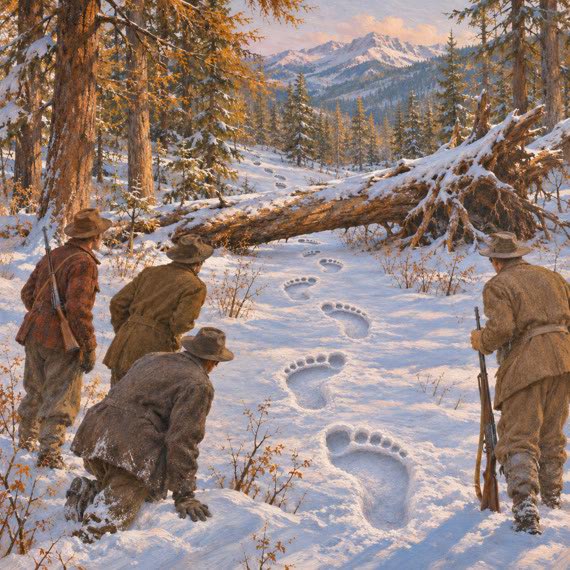
A much older memory occupies a small part of Leo T. Kinney’s history of Petty Creek, Montana. His account, written decades afterward, describes four men returning to retrieve a six-point bull elk and finding only its entrails. Large tracks approached and left the site through snow. Kinney believed something had lifted the animal and carried it away.
The men followed for about half a mile. At a fallen log roughly three feet in diameter, Kinney described marks where the elk’s antlers had dragged through snow on top. The party stopped. Later conversations revealed that the men had shared an uneasiness they had been reluctant to admit at the time. Kinney also remembered a subsequent encounter in which W. W. Schmitz found similar tracks, smelled a strong odour and heard grunting. Schmitz decided to hunt elsewhere. Neither episode included a sighting of the animal itself.
The decision to turn back gives this account its force. Following a trail promises an answer, but an answer can begin to seem less desirable as the distance from familiar ground increases. Kinney’s hunters reached a point where recovering their elk no longer seemed worth meeting whatever they believed had taken it.
A ranger’s trail
The most detailed record in the release concerns the Mill Creek watershed in Washington’s Umatilla National Forest. Here the paperwork moves beyond remembered experiences into a documented field examination. A memorandum dated 18 June 1982 records wildlife biologist Rodney L. Johnson’s findings after a visit the previous day. Accompanied by a group that included an experienced tracker, he inspected alleged Bigfoot tracks in the Low Creek drainage.
There were three reported locations. The group examined two and left the third unvisited. At the first, on the Low Ridge Trail about a mile and a half above Mill Creek, six identifiable impressions extended for approximately twenty-five feet through mud bordered by dense vegetation. Johnson recorded that the tracker could find no continuation beyond the small group of prints. Two were suitable for plaster casts; the remaining impressions were too faint to preserve usefully.
The photographs give the reader something more tangible than an enormous foot described from memory. One right-foot impression was estimated at fifteen inches long and seven inches wide. Its heel had been damaged by an elk stepping across it during the night. Another, a left footprint of similar length, had a conspicuously distorted second toe. White cards marked individual impressions in a wider view of the trail. These were details that could be photographed, measured and returned to later.
The second site lay beside an elk wallow near the Low Creek Trail, roughly two and three-quarter miles above Mill Creek. About eighteen prints covered forty feet, moving out of soft mud, over a small rise and into thick vegetation. Beyond the visible tracks, disturbed plants suggested that something had continued another thirty or forty feet. Two more casts were taken where the ground was firm enough to hold useful impressions. Photographs recorded the footprints before the plaster went in.
Readers can examine the original track photographs in the Forest Service investigation report. They are rough reproductions, but they preserve the progression from an apparently strange discovery to people kneeling in the mud and trying to understand it. One photograph includes watershed rider Paul Freeman’s boot beside an impression for comparison. Other images concentrate on the toes and on a foot-shaped depression pressed over a rock.
What the investigators noticed
Johnson paid close attention to the relationship between the prints and the terrain. At both locations, he found a consistent four-foot stride despite changes in slope. He also observed that members of the party sank more deeply into the mud in their boots than the alleged giant had done. The isolated stretches of tracks, without a readily traceable approach or departure, concerned him. So did the absence of slipping on wet gradients.
Some of his observations were more intricate. At the second site, fine forest litter appeared to have been brushed sideways before a print was made. Certain impressions suggested that a foot-shaped object had been rocked from side to side. Marks extended up the side of the foot, and an arch was pressed down in a way he thought inconsistent with an ordinary step. He concluded that the tracks he examined had been produced by something other than the very heavy, two-legged animal being proposed.
Yet the same memorandum contains an arresting qualification. Fine skin markings in the impressions appeared extremely natural to him. If the tracks had been manufactured, he thought someone had taken considerable trouble over them. He considered whether a cast of a real foot might have provided the detail, while noting that other creases he expected to see were missing. It is an unusually revealing passage, showing the investigator looking closely enough to find both reasons for rejection and features that demanded explanation.
A second memorandum, dated 20 July, records Border Patrol tracker Joel Hardin’s assessment of the same June visit. He regarded the tracks as a carefully made hoax, possibly using a soft plastic or rubber-coated foot. His observations included their straight alignment, consistent stride and abrupt appearance and disappearance without a connecting trail. That was his conclusion about these particular impressions. The file does not identify a proven maker or document an admission.
Johnson stated that the photographic negatives and plaster casts had been handed to the district. The report therefore preserves an actual sequence of fieldwork and interpretation, including the physical material collected along the way. Anyone returning to the case can distinguish what was observed, what was photographed and what the investigators inferred from it.
People at the edge of the woods
Across these records, the encounters take place during ordinary activities. A father and son visit a neighbour. Hunters return for an elk. Forest workers inspect a trail. The strange element enters surroundings that already have a purpose and a history, and the witnesses respond with the resources available to them, whether following tracks, calling someone over or making a plaster cast.
There is no need to turn the October release into a declaration that the government has settled the nature of Bigfoot. The documents are interesting in their own right. They preserve a local newspaper’s excitement, a resident’s unsettling recollections and an investigator’s close examination of muddy ground. Each provides a different way into the question of what people have encountered around the places where they live and work.
The snowy yard is perhaps the most intimate setting of all. A workshop light can illuminate the familiar without revealing what passed through it. By morning, whatever caused the disturbance may be gone, leaving the residents to step outside and look at the ground.
Further Reading
Forest Service Bigfoot Records
Leo Kinney’s Petty Creek History
Bigfoot in Your Backyard Presentation
For a stranger journey into Sasquatch country, episode 16.07 of the Mysterious Universe podcast explores reports of vanishing Bigfoot and the world of psychic Sasquatch. Join Mysterious Universe Plus+ at the Max tier to stream this episode and the available back catalogue.
Trending Podcasts
-
 36.13 I MU Podcasts
36.13 - MU Podcast - MU Interviews - Charlie Robinson - 002
-
-
-
 36.14 I MU Podcasts
36.14 - MU Podcast - The Tayos Caves Mystery Part 1
-
 36.16 I MU Podcasts
36.16 - MU Podcast - Beneath the Pyramids
-
 36.19 I MU Podcasts
36.19 - MU Podcast - MU Interviews - Joshua Cutchin - 003

Julian Vale writes about strange encounters, unexplained events and the mysteries of remote places. His features bring together eyewitness accounts and overlooked stories, following the connections between experiences separated by time and geography.
Previous article