



Nov 16, 2026 I Rowan Ashford
The children followed the woman into their parents’ bedroom. She had walked through the house like an ordinary visitor, dressed in black, and they watched her lie down on the bed. Only then did they become frightened enough to fetch their father. When he came back with them, there was nobody there.
That was how an extraordinary San Francisco haunting began, according to a newspaper account circulated in 1862. The family lived on Kearny Street, between Greenwich and Lombard, on Telegraph Hill. Its father, a stevedore identified only as George, initially supposed that a neighbour had called while he and his wife were out. The children’s description seemed strange, but a visitor who had already gone would explain an empty bedroom.
The next appearance was harder for the household to dismiss. The two young children said the same woman was walking towards the bed again. Their parents could see nothing. One child described blood on the visitor’s face; as she supposedly pressed it against the pillow, a wet red stain appeared on the white fabric. The adults were being asked to reconcile an invisible visitor with something they could see for themselves.
Disturbances followed. Furniture and dishes were overturned or broken. George’s older stepdaughter reported being struck by the woman, with bloody marks appearing on her face. His wife heard a rap beneath her chair and, finding nothing under it, asked whether a spirit was present. The account describes an answering voice close to her ear, followed by the chair carrying her around the room.
Eventually the family did what people living with a frightening house might reasonably do. They left it. Their new address was on Montgomery Street, near Green, still on Telegraph Hill. But the woman in black appeared there too.
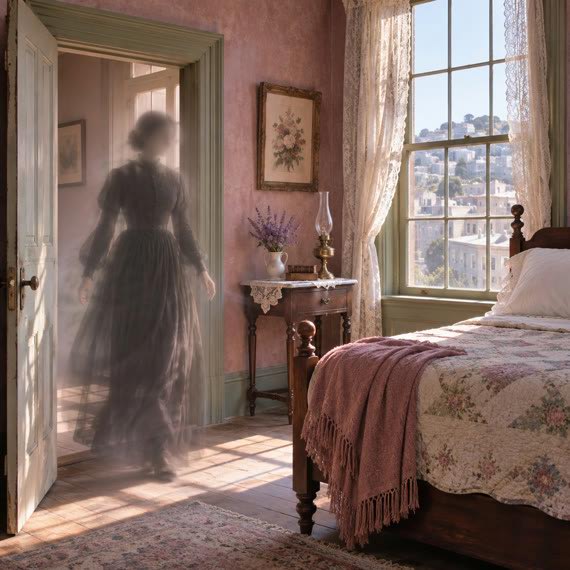
An unwelcome visitor at the next address
The newspaper narrative did not stop at the second house. On a subsequent occasion the older girl visited another household, identified through the initials of its residents. Rumours had drawn a crowd of thirty or forty people to hear about her experiences. In daylight, the girl announced that the woman was approaching with a bloody hand. A blow was reported, and marks like bloodied fingers appeared on her face. While another woman cleaned her with a damp towel, that woman was apparently struck as well.
The original account distinguished between the people who said they saw the apparition and those who described its effects. It also mentioned stained water, marked bedclothes and material being retained for examination. No result of that proposed examination accompanies the story. What survives is a report of a family whose attempts to get away had failed, and whose trouble seemed able to enter somebody else’s home with them.
Leaving a haunted house offers a practical answer to a terrifying situation. Another bedroom, another street and another front door ought to provide some distance from whatever happened. In accounts like this one, the familiar sound or appearance at the new address changes the nature of the experience. The family can no longer assume that the building they left was the whole of the problem.
A month of peace in Amherst
Seventeen years later, in Nova Scotia, another household offered refuge to someone who believed she was being pursued. Esther Cox had become the centre of disturbances at the Amherst home of her sister Olive and brother-in-law Daniel Teed. Walter Hubbell’s account of the case describes frightening noises, moving objects and fires. By January 1879, fear that the trouble would endanger the house had made Esther’s continued presence intolerable.
Daniel went out into the snow to ask John White whether he would take her in. White consulted his wife, who agreed. Esther put on her hat and cloak and left the Teed cottage for a household willing to give her a chance. Hubbell makes this change of address the beginning of a chapter with an unambiguous title, “Followed by the Ghost.”
The return was not immediate. For two weeks at the Whites’ home, Esther heard nothing of the presence. Hubbell describes her growing happier and less afraid, helping with sewing and housework and being treated kindly by her hosts. Towards the end of the third week, people were saying that the Teed cottage was quiet as well. There was reason to hope the move had brought the episode to an end.
Then, at the end of the fourth week, Esther was scrubbing the hall when the brush reportedly disappeared from her hand. She called for Mrs White and her daughter Mary. They searched the hallway and the water in the bucket, but could not find it. After they had given up looking, the brush fell from above, narrowly missing Esther’s head.
It is a small domestic object on which to hang such a disturbing moment. A brush has a particular place in a particular task. Its disappearance interrupts something as ordinary as cleaning a floor, and its return from the ceiling makes that ordinary task impossible to resume in quite the same spirit. In Hubbell’s telling, the refuge had acquired the very uncertainty Esther had hoped to leave behind.
Home was not the only place where it reportedly accompanied her. Esther worked in White’s dining saloon, and the narrative describes disturbances there too. A cooking-stove door repeatedly opened and closed until White braced it with an axe handle. According to the account, the door then came off its hinges and both it and the handle were thrown into the air. Hubbell records a repetition in the presence of fisheries inspector W. H. Rogers and White’s son Frederick.
The account moves between private rooms and a place of business, between a young woman’s experiences and those attributed to people around her. John White’s act of hospitality had offered Esther a new daily routine as well as a bed. What made the recurrence so distressing was that it reached into both.

Six months to find them again
An Australian story told on the podcast during a discussion of Kapunda carries the same pattern through a succession of homes. The family kept moving, and each new address initially seemed to offer an escape. After roughly six months, the ghost would show up again. The move would have changed the surroundings, but not the presence that eventually returned.
That interval is the detail that makes the account linger. Six months provides time to settle, unpack and begin to trust a place. It is long enough for a new house to become home. A return then would carry a different weight from a disturbance on the first night, when everything is unfamiliar and everyone is alert to noises.
There is no reason to impose that timetable on other cases. Esther’s reported respite at the Whites’ lasted weeks. The Telegraph Hill family’s move is described without a comparable waiting period. The connection is the experience of relief followed by recognition, when something at the new address reminds the witnesses of what drove them from the old one.
From a bungalow to a trailer
Jackie Hernandez’s account offers another version of that delayed return. After frightening experiences in a San Pedro bungalow in 1989, she left and subsequently moved into a trailer in Weldon, California. There was a period when the activity seemed to have stopped. By March 1990, however, disturbances were being reported at the trailer.
The later chronology includes strange lights, tapping at windows and voices associated with a storage shed. It also records an especially unnerving incident on 1 April, when neighbours helping move a television reportedly saw an old man’s face in the screen. Hernandez later moved again, and experiences were said to persist before gradually subsiding. Barry Conrad’s film and book, An Unknown Encounter, became major accounts of the case.
The distances involved make this a useful companion to the older stories. Whatever explanation the witnesses gave the events, their account was no longer confined to a single bungalow or its attic. The quiet period at the next home was part of the story, followed by the recognition that the previous experiences might not be over.
Doris Bither, whose experiences inspired The Entity, also reported trouble after leaving the original house in Culver City. In a retrospective account published by the University of California, investigator Kerry Gaynor recalled that the activity followed her move. That led him to consider whether the phenomenon was connected with Bither herself. Her son Brian Harris later described the move to Carson in an interview. He remembered far less activity there, saying, “The paranormal stuff was very rare at that point.” In his account, the hostile, physical experiences belonged to the Culver City house. The change of address had made a considerable difference, even if it had not ended every strange experience.
These are people’s accounts, rather than scenes to borrow from the films made about them. Changing houses was a real decision with practical consequences for the families. Their descriptions of what happened afterwards belong to the continuing experience, even when a famous address becomes the part of the story everyone remembers.
What comes through the door
A place can acquire a reputation while the people at the centre of its haunting disappear into the background. Visitors remember a room, a staircase or an attic. A family trying to escape is concerned with something more immediate, whether the next home will be somewhere they can sleep, raise their children and carry on without fear.
The following accounts preserve that hope. The Whites welcomed Esther into their household. Hernandez found a new place to live. The Telegraph Hill family exchanged one street for another. The Australian family in the podcast story kept trying again. Each move represented a decision to act, followed by some degree of waiting to discover whether it had worked.
None of these accounts requires every haunting to behave in the same way. Some describe a visible figure, others noises, lights or objects moving. Even the people involved may disagree about what has attached itself to them or why. Their shared predicament is simpler and more unsettling than any single explanation. They have left the place where it began, yet something familiar has entered the new home.
For George’s family on Telegraph Hill, that familiarity had a human shape. The children had first taken the woman in black for a visitor. After the move, the distinction between a visitor and a resident must have become harder to bear. She had apparently found the next address without being invited.
Further Reading
Telegraph Hill’s Woman in Black
Kapunda’s unsettling stories feature in 29.08, Outback Birdman, an exploration of Australia’s paranormal danger zones. Keep listening with Mysterious Universe Plus+ at the Max tier for streaming access to this episode and the available back catalogue.
Trending Podcasts
-
 36.13 I MU Podcasts
36.13 - MU Podcast - MU Interviews - Charlie Robinson - 002
-
-
-
 36.14 I MU Podcasts
36.14 - MU Podcast - The Tayos Caves Mystery Part 1
-
 36.16 I MU Podcasts
36.16 - MU Podcast - Beneath the Pyramids
-
 36.19 I MU Podcasts
36.19 - MU Podcast - MU Interviews - Joshua Cutchin - 003

Rowan Ashford covers strange creatures, hauntings and local legends. He takes a particular interest in older reports and the details that disappear as stories pass from one teller to the next.
Previous article
Related Articles