

Nov 22, 2026 I Rowan Ashford
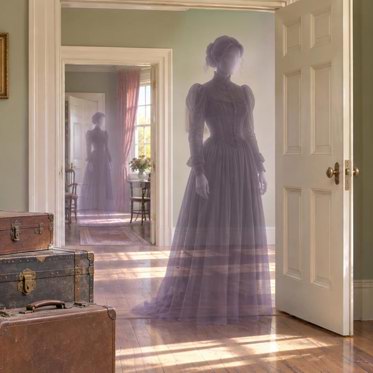
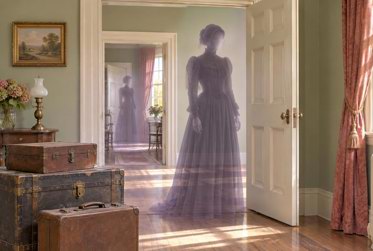
At Hoar Cross Hall, the girl looked enough like a member of the family that the new owners initially took little notice. She was upstairs, dressed in Victorian clothes, and they assumed one of their daughters was playing dress-up. When she appeared again a few days later, Gwyneth Bickerton-Jones called her daughter’s name. According to the account preserved by ghost researcher Andrew Green and retold by Alan Murdie, the child vanished in front of her.
The family had bought the Staffordshire hall in 1970 and begun extensive renovations. Their plans involved opening the property to visitors and holding medieval-style banquets. They were bringing people, work and activity back into a large old house. In the story that followed, something else seemed to have become active too.
Renovation has an obvious direction: towards a more comfortable, usable home. New wiring, replastered walls and reopened rooms should make an unfamiliar property easier to inhabit. Yet a recurring group of haunting accounts begins at precisely this point. A house is altered, and its occupants begin hearing movement where nobody is working. A figure appears in a room being returned to use. Builders who arrived to repair a property find themselves reluctant to remain inside it.
These accounts belong beside a different but equally unsettling experience: a family moving into a newly built house and discovering, sometimes years later, that new walls have not guaranteed an uneventful home. Two recent editions of Danny Robins’s Uncanny bring those experiences together. One concerns a modern family home in Kent. The other follows a renovation in South Wales that acquired a name its developer had never intended: Project Ghost.
A child among the renovations
The Hoar Cross apparition has a particularly domestic beginning. Before her disappearance, the girl was interpreted through the ordinary life of the household. A parent recognised what appeared to be a child playing in old-fashioned clothes. Only when recognition was attempted did the encounter become something stranger.
A member of that household has subsequently written extensively about growing up there. Viv Wilson, née Bickerton-Jones, describes the move to the seventy-room hall as the fulfilment of her father’s ambition to display his collection of antiques. Her memories place the ghost stories within a busy family home, rather than an abandoned building approached for a single night’s adventure.
Wilson remembers hearing a child crying while she was awake reading in bed. She also recalls the previous owner telling the family about banging doors, cold areas and a crying child. Those recollections complicate the idea of a haunting created entirely by the renovation: the house apparently had stories before the new family arrived. The work may have coincided with renewed encounters, rather than introducing a presence that had never been reported there before.
That distinction makes the account more interesting. A restoration can bring a neglected room back into daily life and put a family into spaces earlier occupants seldom entered. The question becomes what the returning activity means to anyone, or anything, already associated with the place. At Hoar Cross, the most memorable reported encounter was an apparent child who briefly fitted into the new household before disappearing from it.
The passage behind the alterations
At the Queen’s Head Inn in Blyford, Suffolk, the connection was described more directly. Murdie, drawing on Joan Forman’s Haunted East Anglia, records noisy disturbances in 1969–70 following structural alterations and the discovery of a passageway. In this account, the manifestations were said to have begun after the changes.
A recovered passage gives that sequence a physical focus. The builders had exposed part of the building that had been concealed; the subsequent noises appeared to give the reopened space another kind of occupancy. What survives of the account centres on that sequence: a concealed part of the inn was revealed, and the building subsequently became a source of unfamiliar noise.
For somebody who has lived through a similar change in a home, that order can be more compelling than an ancient reputation. There is a remembered period when the house was ordinary. Then the work happens, and the experience of living there changes. The familiar rooms provide the comparison. A person does not need to have arrived expecting ghosts to notice that the place now feels inhabited in a different way.
Workers who would not go back alone
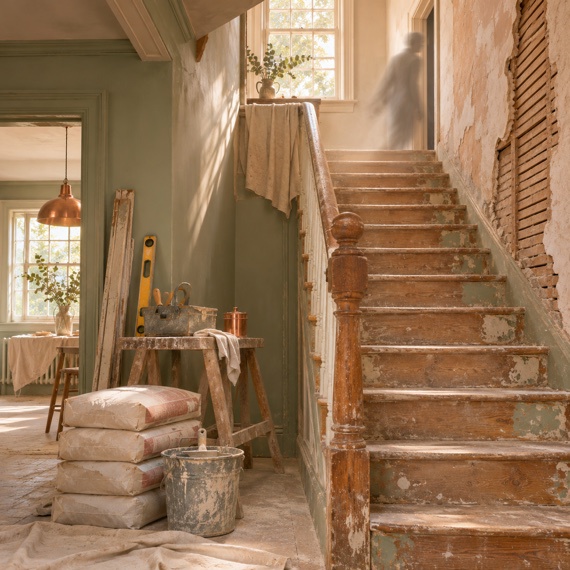
In Westlake, Louisiana, the work involved restoring a house Ray Doran had purchased in 1999. The local investigation group Louisiana Spirits later recorded his account of disturbances during the renovation. Workers gathered their tools in one place at the end of each day. A staple gun disappeared from that inventory, resisted a search of the property, then reportedly turned up weeks later at the storage point.
Other experiences were more immediate. A woman helping with the reconstruction heard a voice while alone. After looking for another person, she left and would return only with company. A painter heard movement upstairs, but it stopped when he went to investigate. He subsequently wanted his Bible with him when entering the house.
The investigators also recorded a reported light near a bathroom during their own visit. Their later return produced no recorded paranormal phenomena. What remains distinctive in their report is the workers’ practical response: companionship for one, a Bible for another. Whatever they believed was present, it had become part of how they approached an ordinary working day.
There is an intimacy to a renovation crew’s knowledge of a house. Workers encounter rooms before furniture and decoration disguise their structure. They repeatedly enter and leave, hear other trades moving between floors and learn where their equipment belongs. In the Westlake accounts, the strange events interrupted those routines. The missing tool eventually returned to the place where it should have been all along; the movement upstairs ceased just as someone arrived to look.
A project the builders abandoned
That reluctance to work alone becomes a much larger problem in the South Wales case featured in Uncanny on 17 November 2026. The programme introduces Dean, a developer who bought a derelict house intending to renovate and sell it. Instead, the job became associated with disturbances that reportedly drove builders away.
Watch the original Project Ghost account
The episode’s published account describes footsteps, displaced or thrown tools, and workers suffering headaches and nausea. One builder reportedly said he had been pushed down the stairs. The name Project Ghost came to express a problem no construction schedule had allowed for: people unwilling to continue inside the building.
A published synopsis of Dean’s interview adds another unsettling strand. Neighbours allegedly saw lights and a silhouette, and heard music, when the house had no power supply. Police were called. A local vicar eventually conducted a blessing, after which the workers returned and the renovation was completed. Dean described the disturbances as having subsided.
The appeal of the account lies in the clash between two forms of occupation. To the developer, the house was a job with a sequence of tasks and a finished condition. To the people reporting the encounters, it seemed capable of answering their presence. A building being prepared for new occupants had acquired an apparent occupant of its own, one whose behaviour affected whether the work could proceed.
The renovation did eventually finish. That matters as much as the departure of the builders. These stories are lived between decisions about money, deadlines, safety and where people are willing to spend their time. The strange becomes entangled with the practical, until a blessing can enter the project alongside the work originally planned.
New walls on older ground
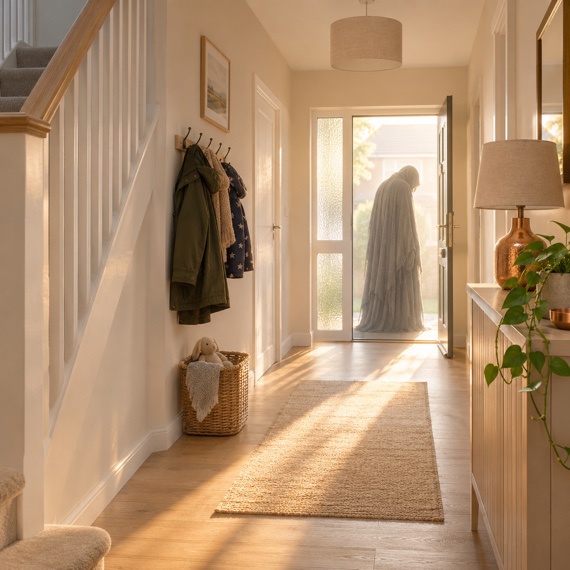
Cliffsend offers a different starting point. Lindsey’s family moved into a newly built house on the Isle of Thanet in Kent and lived happily there for years. The disturbances were not presented as an immediate response to a move. An ordinary family home gradually became associated with repeated footsteps, moving door handles and a hunched, cloaked figure.
Watch Lindsey’s original Cliffsend account
The recent programme returns to the experience of a family trying to live with that change. A new house carries none of the obvious visual cues of a ruined abbey or a long-empty hall. There is no need to approach it through a history of previous residents. Its unsettling quality comes from the distance between what the family knew of their home and what they began reporting inside it.
The landscape provides a further connection, though not a simple identification of the alleged figure. Wessex Archaeology’s excavations at Cliffs End Farm in 2004–05, undertaken before housing development, revealed prehistoric occupation and extraordinary mortuary deposits. The site’s history includes Bronze Age activity and later Saxon use. Radiocarbon dating and isotope research helped investigators examine people whose lives belonged to a landscape very different from the modern village.
Those discoveries establish a deep human history in the area. They do not tell us who Lindsey’s family believed they saw, nor do they establish that her house stood directly over a particular burial. Their relevance is broader and more evocative. A building can be new while the ground around it has been lived on, crossed and used for ceremonies over many centuries.
Cliffsend therefore belongs with the renovation cases without needing to be forced into their sequence. Hoar Cross, Blyford, Westlake and the Welsh building site involve people changing existing structures. Lindsey’s family encountered something in a house that had begun as a new home. Together, the accounts unsettle the assumption that haunting must be visible in the age and appearance of the walls.
Making room for someone else
There is no single explanation offered by the people who tell these stories. Some understand the activity as an objection to disturbance. Others imagine an old presence becoming noticeable when a room, passage or household comes back into use. A newly built home raises the further possibility that whatever is being encountered belongs to a place rather than its present architecture.
What gives the accounts their force is the change in a relationship. A house that could be understood through rooms, tools and family routines begins to suggest another presence. At Hoar Cross, it took the form of a child who vanished when addressed. In Westlake, workers changed the conditions under which they would return. In South Wales, the whole project had to accommodate what its participants believed was happening.
The work was meant to make these places fit for people to live in. The haunting stories begin when those people start to wonder whether they are the only ones being accommodated.
Further Reading
Viv Wilson’s memories of the hall
Project Ghost episode synopsis
For another homeowner’s extraordinary experiences, hear Frances Kermeen discuss the Myrtles in Mysterious Universe episode 14.23. Join Mysterious Universe Plus+ at the Max tier to stream the episode and explore the available back catalogue of encounters and mysteries.
Trending Podcasts
-
 36.13 I MU Podcasts
36.13 - MU Podcast - MU Interviews - Charlie Robinson - 002
-
-
-
 36.14 I MU Podcasts
36.14 - MU Podcast - The Tayos Caves Mystery Part 1
-
 36.16 I MU Podcasts
36.16 - MU Podcast - Beneath the Pyramids
-
 36.19 I MU Podcasts
36.19 - MU Podcast - MU Interviews - Joshua Cutchin - 003

Rowan Ashford covers strange creatures, hauntings and local legends. He takes a particular interest in older reports and the details that disappear as stories pass from one teller to the next.
Previous article