

Nov 21, 2026 I Julian Vale
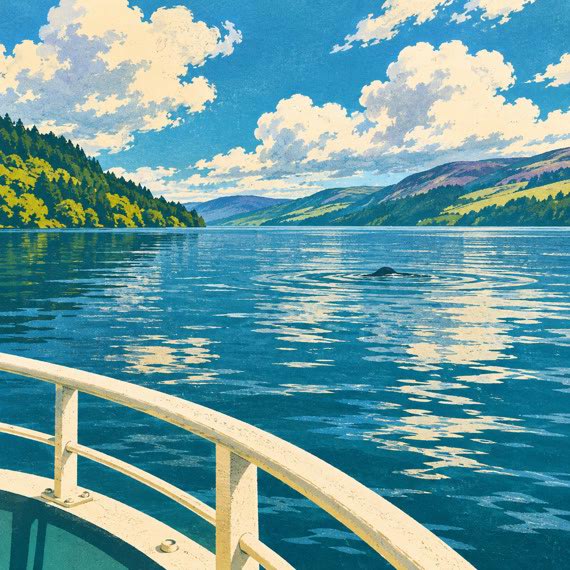
Crystal was on the lower deck of a cruise boat when she took the photograph. It was half past eleven on 23 July 2026, and the nine-year-old was visiting Loch Ness from Australia with her family. What she described to the sightings register was the head of a creature in the water. The account takes only a few lines. The register gives no estimate of its size or how far away it was. The photograph is there for anyone to look at, and beside it is the small but useful detail of where she was standing. Crystal had a low view from a boat on the loch. Two days earlier another Australian visitor, Oscar Gray, had been down by the shoreline at Urquhart Castle when he saw something he also described as a head. He gave it a different shape and had rather more to say about what followed it. See Crystal’s original photo here.
In November the number of reports made news. The Loch Ness Monster Sightings Register lists fifteen for 2026, up from six in 2025. The newest account on the page is dated 21 August. The November headlines, in other words, brought a summer's encounters back into circulation. There is something slightly misleading about meeting these accounts first as a number. A woman at a high viewpoint describing a dark mound half a mile away and a person on a boat glimpsing something close to the hull have been put in the same column of the register. Read their descriptions in order of where the people were standing and a rather different story emerges. Some saw a shape first. Some found it by noticing what the water was doing. One man came across his sighting after he had left the loch altogether.
From the boat
In March, Tony Inhorn was aboard a boat near the opening of the Caledonian Canal when a dark greenish-grey shape came up through the chop. He put it about fifteen feet away. He judged that the exposed portion was five to ten feet long and rose about two feet out of the water. What came up, in his telling, looked like a portion of a body rather than the whole of it. He thought he could have been seeing the back, or the side as it came out at an angle. Inhorn put the time it remained up at about five seconds. He drew what he remembered, which is useful for seeing where he thought the line of the water cut across the shape. At that range he could report the way it stood out from the surrounding waves. A little farther off and he might have come away, like several of the summer witnesses, with the impression of a single dark mound.
There was a different encounter on 25 July. A local sailor was taking his yacht along the middle of the loch, about two miles west of Glenmoriston by his account, when he spotted something off his starboard quarter. He estimated the distance at a hundred metres, between the yacht and the north shore. The comparison he settled on was an oversized crocodile's head. The water was slight and visibility good, he said. The head went down before he got a photograph. By the time he had taken in what he was seeing, the chance was gone. He carried on to Fort Augustus without seeing it again.
Crystal's encounter falls between those two descriptions in a curious way. Her camera caught what made her look, but the detail the sailor thought he recognised depended on the view he had for himself. One of the other July reports reverses even that arrangement. John and Jamie Wallace, visiting from Renfrewshire, photographed a shadow on the morning of 27 July. The point they made to the register was that nothing was above the surface. For them the thing worth photographing was the dark area in the water, without a head or a back breaking through it to give it a familiar outline. See the Wallaces’ original photo here.
From the castle and the road
At the shoreline by Urquhart Castle, Oscar Gray described seeing the top of a dark green, flat-looking head well out from shore. He said that two humps of the same colour came up behind it. Farther back he saw lines of ripples and white water. He took those to be the action of a tail and described the whole shape going down after the water broke over it. The report keeps the order in which it made sense to him: the head, what he took to be the body, and then the disturbance behind it. That last detail is worth keeping in mind when reading other accounts. People often describe a tail when the only visible part of it, in the telling, is what they think it did to the water.
Jocelyn Boyce had a view from higher up at the same castle on 6 August. She was there with family, the water looked calm, and she estimated the distance to the object at about half a mile. The dark shape stood above the surface and looked to her like a mound. She saw it with the naked eye before using her phone's zoom and recording about thirteen seconds of video. There was a shape above the water in one photograph and she could no longer see it there in another taken moments later. The register has a still from the video. At a castle overlook it is possible to take in a great stretch of water at once. Boyce had good conditions to watch a shape come and go, but still needed the zoom to get the view she wanted from the phone. See the original still here.
The road gives a witness a much shorter view. In April, Sara Gubicza was on a bus travelling south from Inverness when she saw what looked to her like a whitish-grey triangular fin going the other way. She was careful about the speed because the bus itself was moving. A month later Nickolas Wiegand was filming from a tour bus. He recalled watching through the viewfinder and only discovering what interested him when he went back to the footage after the tour. There had been something dark far out in the loch, he thought, breaking the surface as the bus went by. He went looking for road signs in the recording to give himself a sense of scale. Gubicza had to account for the movement of the bus while recalling what she'd seen. Wiegand could go back through the frames, but he could never turn his head and look at the water at that moment again.
A quarter of an hour at Fort Augustus
Norbert Kawka, visiting from Malta, reported a longer watch on the evening of 5 August. Near Fort Augustus at about ten to nine, in fog and a hint of rain, he said he watched something that moved in and out of the water like a very large eel. He thought it was going against the current. He put its length at seven metres or more and his time watching it at about fifteen minutes. He reported calm water, no wind and no boat activity. The amount of disturbance it left behind was part of his account. Fifteen minutes is long enough for something seen briefly to become something a person can follow, and it is the length of that watch that makes Kawka's report stand out among the others. See Kawka’s original photo here.

There is an older stretch of film that makes sense alongside Kawka's account. On 23 April 1960, Tim Dinsdale filmed a moving shape from the shore on the last day of his first visit. His film went to the Joint Air Reconnaissance Intelligence Centre through the Loch Ness investigation, which was submitting material for interpretation by people accustomed to looking closely at aerial imagery. The film gives an object and a moving wake time to develop in the frame. That was the advantage of keeping the camera trained on the water. The disadvantage, familiar from the view at Urquhart Castle, was that distance carried away much of the detail the eye wanted. See Dinsdale’s footage in this BBC Scotland segment.
A decade later a team associated with Roy Mackal tried putting a camera on the other side of the surface. According to the National Oceanography Centre, the recovered apparatus is believed to be one of six deployed in 1970. The camera sat in a waterproof housing and could take a short sequence of flash pictures when something took a bait line. An underwater robot testing in Loch Ness found it by chance, when part of the old mooring snagged its propeller roughly 180 metres down. The centre announced the recovery in 2025. An engineer developed surviving film, and the camera, housing and film went to the Loch Ness Centre. The recovered frames showed no apparent monster. What survived instead was an attempt to get the view missing from all those photographs taken from above.
The latest dated report in the register comes from Felix Tiekemeier, visiting from Germany on 21 August. He said something black surfaced about three hundred metres away, stayed at the surface for roughly twenty seconds, then disappeared. He thought it appeared to have a head and estimated a length of about six metres. The picture he took now sits at the top of the year's entries. It would be easy to begin there, work back down the page and make each witness answer the same question. But Crystal had the view from the lower deck, Kawka had time to watch a disturbance travel across calm water and the Wallaces had a shadow that never came up at all. Each went to the loch and came back with a little of what the others couldn't see. See Tiekemeier’s original photo here.
Further Reading
Loch Ness Monster Sightings Register
Loch Ness Investigation Bureau report
Tim Dinsdale’s film on BBC Scotland
The recovered Loch Ness camera trap
The Loch Ness stories get stranger the farther you follow Ted Holiday. Hear about his investigations and accounts of other Scottish water creatures in The Occult Wyrm on the Mysterious Universe podcast. MU Max gives you streaming access to the extended episode and the available back catalogue.
Trending Podcasts
-
 36.13 I MU Podcasts
36.13 - MU Podcast - MU Interviews - Charlie Robinson - 002
-
-
-
 36.14 I MU Podcasts
36.14 - MU Podcast - The Tayos Caves Mystery Part 1
-
 36.16 I MU Podcasts
36.16 - MU Podcast - Beneath the Pyramids
-
 36.19 I MU Podcasts
36.19 - MU Podcast - MU Interviews - Joshua Cutchin - 003

Elias Mercer writes about unexplained phenomena, unusual encounters and the stories that gather around mysterious places. His features connect contemporary reports with older accounts, exploring the details that make them worth remembering.
Previous article